Adobe's CX Coworker Goes Agentic — Lessons for SMB Marketing
Adobe just rewrote the marketing org chart
On April 20, 2026, Adobe used the opening keynote of Adobe Summit to retire the Experience Cloud brand and replace it with Adobe CX Enterprise — anchored by a new product called CX Enterprise Coworker, a fully agentic AI system that monitors signals, plans next-best actions, and executes campaigns across channels with humans kept in the loop.
For a small business owner, “Adobe enterprise software” usually translates to “not for me.” That instinct is half right — the CX Enterprise license itself starts well above an SMB budget. But the playbook Adobe just shipped, and the open standards it runs on, are about to reshape every marketing tool a small business already uses. This post unpacks what Adobe announced, why a persistent agent is meaningfully different from the ChatGPT-style assistants you already know, and what to copy from the Adobe CX Enterprise Coworker SMB-relevant pieces today.
What Adobe actually announced at Summit 2026
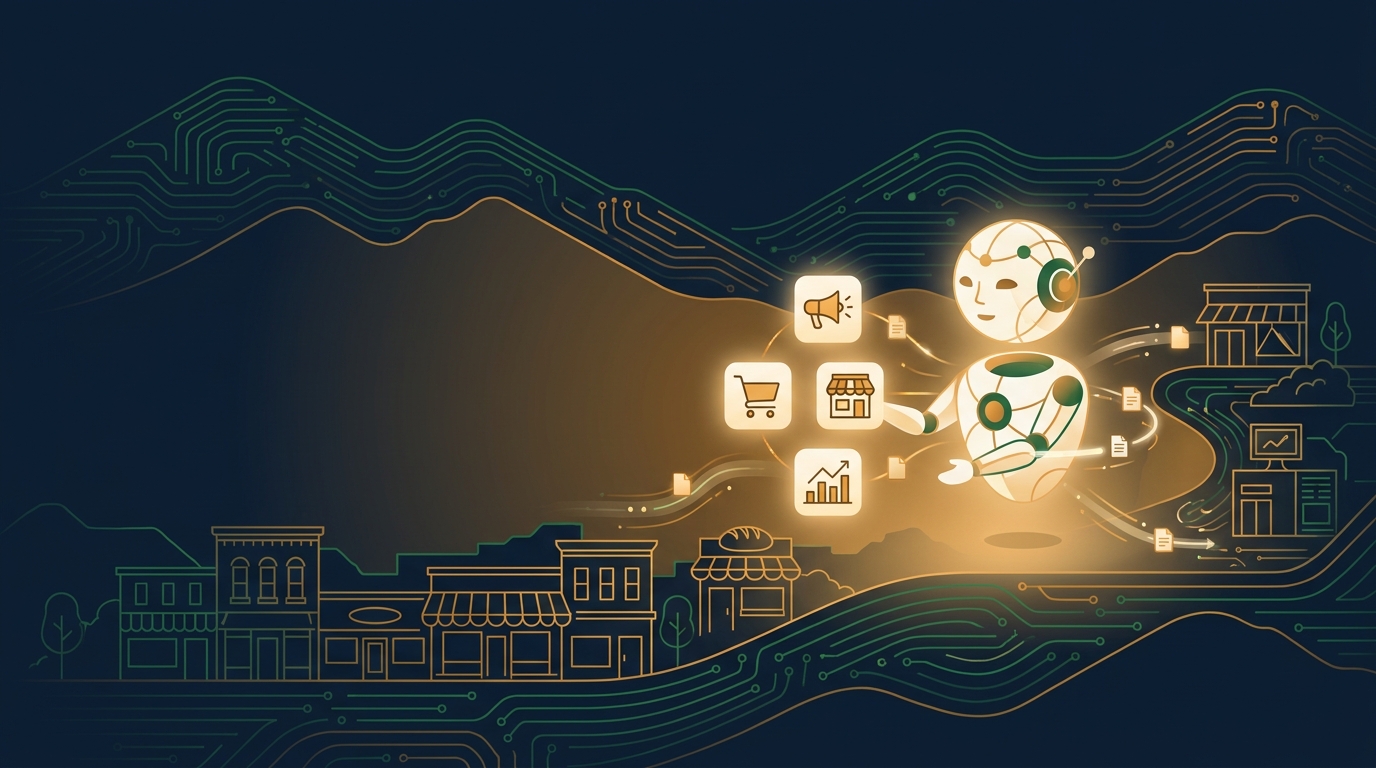
The headline product is CX Enterprise Coworker — Adobe’s framing for an AI marketing agent that operates against persistent business goals rather than one-off prompts. According to Adobe’s Summit announcement, the Coworker activates insights from Adobe Experience Platform, Real-Time CDP, Customer Journey Analytics, and Journey Optimizer to plan and execute experiences across channels.
The piece that matters beyond Adobe customers is the architecture. Coworker is built on two open standards:
- Model Context Protocol (MCP) — the same connector standard Anthropic donated to the Linux Foundation last December, now supported by ChatGPT, Claude, Gemini, Microsoft Copilot, and a growing list of business tools.
- Agent2Agent (A2A) — a newer protocol that lets agents from different vendors hand work to each other safely.
Because it speaks both, Coworker can operate across AI platforms from AWS, Anthropic, Google Cloud, Microsoft, and OpenAI. That is a strikingly open posture for a vendor that, until recently, sold a closed marketing suite.
Adobe also expanded partnerships with WPP, Publicis, Accenture, and Deloitte to operationalize the Coworker for enterprise clients. Translation: the agencies that serve the Fortune 500 are about to learn how to deploy persistent marketing agents at scale, and the techniques will trickle down within a year.
Persistent agents vs task-based agents — the real shift
The most important word in the Adobe announcement is persistent. Most AI tools small businesses use today are task-based: you open ChatGPT, paste a prompt, get an answer, close the tab. The agent has no memory of what you asked yesterday and no goal of its own.
A persistent agent works differently. You give it a standing objective — say, “keep our cost-per-lead below $40 for the spring HVAC season” — and a set of tools it can use. It then watches the data, notices when CPL drifts, drafts a new ad creative, asks for human approval, ships the change, and keeps watching. The work continues whether or not you are looking.
The implications run deep:
- Goals replace prompts. You configure the outcome you care about; the agent works backward from there.
- Memory becomes infrastructure. What the agent learned last Tuesday informs what it tries on Saturday. Customer Journey Analytics in Adobe’s stack is essentially a memory layer for marketing agents.
- Approval becomes the bottleneck. When agents can act 24/7, the human’s job shifts from doing the work to reviewing what the agent proposes. Adobe’s Coworker keeps humans in the loop by default, and that is the right pattern.
This is the same shift we covered in our look at the pragmatic agentic AI moment of 2026 — the industry moving away from “AI as autocomplete” and toward “AI as a coworker with a job description.”
Why MCP and A2A standards matter for SMB tool stacks
A small business will probably never buy CX Enterprise Coworker. But every small business already buys tools that will start speaking MCP and A2A this year. Meta opened its ad ecosystem to ChatGPT and Claude over MCP in late April. Google’s Gemini Enterprise Agent Platform supports MCP natively. And we walked through the broader story in MCP is becoming the USB-C of AI agents.
What that means in practical terms:
- The CRM, email tool, ad platform, and review tracker you already use will increasingly expose an MCP server.
- A single AI agent — Claude, ChatGPT, Gemini, or one your AI provider builds — will be able to read from and write to all of them through one common protocol.
- The “integration tax” that has historically priced small businesses out of marketing automation drops sharply, because every vendor builds one connector instead of dozens.
Adobe choosing MCP and A2A is less a gift and more a competitive necessity. Closed marketing clouds are a 2015 idea. Open agent stacks are how 2026 marketing tools earn their place.
How the enterprise CX agent playbook trickles down to SMBs
Look at the four Coworker capabilities Adobe is selling to the Fortune 500 and squint:
| Enterprise capability | SMB equivalent that already exists or is arriving |
|---|---|
| Persistent goal-driven agents | Single-purpose AI Employees with one job each |
| Real-Time CDP customer data unification | A CRM plus an MCP-aware AI assistant |
| Customer Journey Analytics | Google Analytics 4 plus an LLM that can read it |
| Journey Optimizer for cross-channel orchestration | Email tool plus ad platform plus AI to coordinate |
The capabilities aren’t reserved for companies with seven-figure martech budgets — they just arrive packaged differently. Where an enterprise buys one suite, a small business stitches together three or four affordable tools with an AI agent in the middle. The end result looks similar: campaigns that adjust themselves, content that gets drafted in response to performance data, and a human who reviews more than they execute.
That is exactly the shape of small business marketing automation we will see by the end of 2026.
What small business marketers should adopt now
You do not need to wait for the enterprise playbook to fully trickle down. Three moves are reasonable today:
1. Pick one persistent goal and build around it. Instead of using AI to draft a one-off email, define a quarterly objective — “grow newsletter subscribers by 20%” or “keep our Google review average above 4.6 stars” — and let an AI tool work against it across multiple sessions. Content Forge is built for this kind of recurring, goal-driven content production rather than one-shot prompts.
2. Treat MCP support as a buying criterion. When you renew or evaluate a marketing tool — CRM, email, social scheduler, ad platform — ask whether the vendor supports MCP or has a public roadmap to. The tools that say yes will plug into whatever AI assistant you adopt next. The ones that say no are slowly becoming islands.
3. Build a human-in-the-loop habit before you need it. Adobe’s most quoted line from Summit was that the Coworker is “autonomous with human oversight.” That is the right ratio for small businesses too. Set up your AI tools to propose changes — new ad creative, refreshed email subject lines, repriced services — and approve them yourself for the first 60 to 90 days. The review habit is what keeps an agent useful instead of expensive.
If you want help shaping the right agent setup for a five- or ten-person business, our small business solutions team builds practical, owner-friendly stacks that lean on the same MCP-native standards Adobe is leaning on.
The bottom line for Appalachian businesses
Adobe Summit 2026 was an enterprise event with a small business message buried inside it. The era of one-off AI prompts is winding down. The era of agents that work against persistent goals — read your data, draft your campaigns, coordinate your channels, and check in for approval — is the one your tools are quietly preparing for. You do not have to be a Fortune 500 customer to benefit. You just have to pick one goal, one tool that speaks the new standards, and one habit of reviewing what the agent proposes.
Want help building a persistent-agent marketing setup that fits a small business budget? Get in touch — we help Appalachian businesses adopt the parts of the agentic AI shift that actually pay off.