
88% of Businesses Use AI, Only 6% See Results
The most important AI statistic nobody is talking about
Here is a number that should concern every business owner investing in AI: 88% of companies worldwide now use artificial intelligence in at least one business function. That is up from 20% in 2017, according to McKinsey’s latest global survey.
Now here is the number that actually matters: only 6% of those organizations report earnings impacts exceeding 5% from their AI initiatives. The rest — the vast majority — see no meaningful financial return.
This is not a technology problem. The tools are better, cheaper, and more accessible than ever. The AI adoption gap exists because most businesses treat AI like a product they can install and forget. The companies seeing real results treat it like a capability they build over time.
The numbers that should worry AI vendors
The gap between adoption and results is not closing. It is widening.
According to S&P Global Market Intelligence, 42% of companies abandoned most of their AI initiatives in 2025 — up from just 17% the year before. The RAND Corporation found that over 80% of AI projects fail outright, which is twice the failure rate of non-AI technology projects.
And it gets worse at the enterprise level. BCG’s research shows the average organization runs 4.3 AI pilot programs but only 21% ever reach production scale with measurable returns. PwC reported at the 2026 World Economic Forum that over 50% of companies gained no measurable value from their AI investments.
The pattern is consistent across every major research firm. Gartner predicts that through 2026, organizations will abandon 60% of AI projects unsupported by AI-ready data. They also expect over 40% of agentic AI projects to be canceled by 2027 due to escalating costs or unclear business value.
The AI industry has a delivery problem, not a demand problem.
Why most AI deployments stall after setup
When a small business signs up for an AI tool, the initial experience is usually promising. The chatbot answers a few questions. The scheduling assistant books an appointment. The content generator produces a draft. It feels like progress.
Then reality sets in. The chatbot does not know your pricing. The scheduler does not understand your peak hours. The content reads like it was written by someone who has never visited your town.
This is where most AI deployments die — not with a dramatic failure, but with a slow fade into disuse. McKinsey’s 2025 survey found that two-thirds of companies using AI are still stuck in pilot or experimentation phase. They tried it, it sort of worked, and then nothing happened.
The data problem
The single biggest predictor of AI failure is data readiness. Gartner reports that 85% of AI model failures trace back to poor data quality or a lack of relevant data. If you feed an AI tool generic information, you get generic results.
For a restaurant in Charleston, that means the AI does not know your menu changes seasonally. For an HVAC contractor in Beckley, it means the AI does not understand that a “service call” in July requires different routing than one in January. The tool works. Your data does not support it.
The workflow problem
Most businesses bolt AI onto existing processes without changing anything else. They add a chatbot to a website that still has a phone tree. They use AI scheduling alongside a paper calendar. They generate content with AI and then manually rewrite all of it.
McKinsey found that organizations reporting significant financial returns from AI are twice as likely to have redesigned end-to-end workflows before selecting AI tools. The AI is the last piece, not the first.
The people problem
A Harvard Business Review analysis found that AI initiatives often stall because employees’ anxiety about relevance, identity, and job security drives surface-level use without real commitment. People use the tool just enough to check a box, but never enough to change outcomes.
Only 12% of SME decision-makers report a very good understanding of AI technologies. More than half have only a basic grasp. You cannot get results from a tool you do not understand well enough to configure, train, and iterate on.
The last-mile execution problem
BCG calls it the 10-20-70 rule: 10% of AI success comes from algorithms, 20% from technology and data, and 70% from people and processes. Most businesses spend all their time and money on the first 30% and wonder why nothing changes.
The last mile — the work of actually integrating AI into daily operations, training staff, measuring results, and iterating — is where value is created. It is also where most projects are abandoned.
Consider two restaurants that both adopt an AI review management tool. Restaurant A installs it, connects their Google Business Profile, and waits for results. Restaurant B installs it, trains it on their common review themes, assigns a manager to review AI-drafted responses before they go live, and checks response quality weekly.
After 90 days, Restaurant A has generic responses that occasionally miss the mark. Restaurant B has a review management system that sounds like the owner wrote every reply. Same tool. Different execution. Different results.
This pattern repeats across every AI application. The technology is table stakes. The execution is the differentiator.
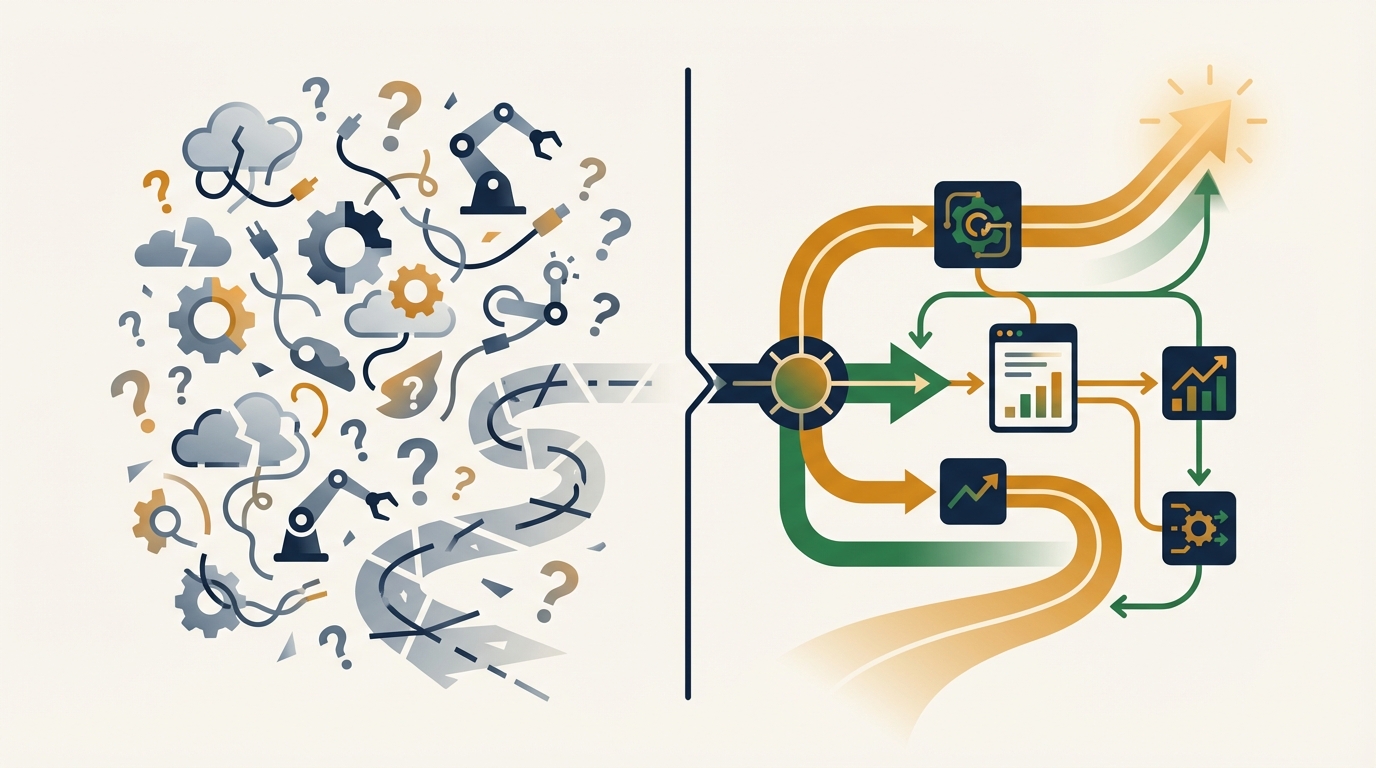
How small businesses can avoid the gap
The good news is that avoiding the AI adoption gap does not require a massive budget or a team of data scientists. It requires a different approach.
Start with one workflow, not ten
The companies in that top 6% did not adopt AI across every function at once. They picked one high-impact workflow, made it work, measured the result, and then expanded. For a small business, that might mean starting with after-hours call handling before trying to automate scheduling, marketing, and inventory all at once.
Pick the workflow where you lose the most money or time. Fix that one first.
Feed it your data, not just any data
Generic AI tools produce generic results. The businesses seeing real returns invested time upfront to give AI tools the right context: their service menu, their pricing, their common customer questions, their seasonal patterns. An AI employee trained on your specific business data performs fundamentally differently than a generic chatbot.
Redesign the process, then add AI
Do not automate a broken workflow. If your intake process involves a customer leaving a voicemail, someone checking it hours later, and then playing phone tag to schedule, adding AI to the voicemail step does not fix the problem. Redesigning the intake to be a real-time conversation — and then using AI to power it — does.
Measure from day one
Set a baseline before you launch any AI tool. How many calls do you miss today? What is your average response time to a new lead? How many hours per week does your staff spend on scheduling? Then measure the same numbers 30, 60, and 90 days after AI adoption.
Without a baseline, you will never know if AI is working. And without knowing if it is working, you will join the 94% who quietly stop using it.
Get help with implementation, not just selection
Choosing the right AI tool is 20% of the challenge. Configuring it, training it, integrating it into your workflows, and iterating on it is the other 80%. This is where working with someone who understands both the technology and your type of business makes a significant difference. AI consulting is not about picking software — it is about making sure the software actually delivers.
Getting results, not just tools
The AI adoption gap is real, and it is growing. But it is not inevitable. The businesses in the top 6% are not using better AI. They are using AI better.
They start small. They invest in data and training before scaling. They redesign workflows instead of bolting AI onto broken processes. And they measure everything.
If your business has tried AI tools and felt underwhelmed by the results, you are not alone — 94% of companies share that experience. But the path from “we tried AI” to “AI transformed our operations” is shorter than most people think. It starts with picking one problem, implementing one solution properly, and building from there.
Ready to close the gap? Explore how Appalach.AI builds AI solutions that are configured for your business, not just installed and forgotten.