
AI Chatbot vs Live Chat for Service Businesses
Your customers need help right now. Who answers?
A homeowner in Parkersburg discovers a puddle spreading across the kitchen floor at 8 PM. A guest checking into a cabin rental near Canaan Valley cannot find the lockbox code. A car owner in Beckley hears a grinding noise and needs to know if they can keep driving.
These people all have the same problem: they need to reach a business, and they need a response now. Not in 30 minutes. Not tomorrow morning. Now.
That puts service businesses in front of a real choice. You can hire staff to handle live chat during business hours — and hope nobody needs you after 5 PM. Or you can deploy an AI chatbot that handles every conversation around the clock. Each option has trade-offs in cost, quality, and customer satisfaction. This comparison breaks down what actually matters so you can make the right call for your business.
At a glance
| Feature | AI chatbot | Live chat (human agents) |
|---|---|---|
| Availability | 24/7/365 | Business hours (or expensive extended shifts) |
| Response time | Under 5 seconds | 1-5 minutes average, longer during peak |
| Simultaneous conversations | Unlimited | 2-3 per agent |
| Monthly cost (SMB) | $50-200/month | $1,500-4,000+/month |
| Cost per interaction | ~$0.50 | ~$6.00 |
| Handles complex/emotional issues | Improving, but limited | Strong |
| Consistency | Identical quality every time | Varies by agent and shift |
| Best for | High-volume routine inquiries | Complex sales, sensitive situations |
The short version
For most service businesses handling routine inquiries — scheduling, lead qualification, basic questions — an AI chatbot delivers better results at a fraction of the cost. Live chat is worth the investment when your conversations require deep empathy, nuanced negotiation, or high-touch sales. The best setup often combines both.
The customer service landscape in 2026
The expectations your customers bring to every interaction have shifted dramatically. According to Zendesk’s 2026 CX Trends Report, 74% of consumers now expect 24/7 support, and 81% say AI has become a standard part of modern customer service. Meanwhile, 85% of CX leaders say a single unresolved issue is enough to lose a customer permanently.
Service businesses in Appalachia feel this pressure acutely. A three-person HVAC company cannot staff a chat desk around the clock. A vacation rental manager juggling 15 properties cannot answer every guest message within two minutes. But their customers expect exactly that — because their competitors are starting to deliver it.
The question is no longer whether to offer real-time customer communication. The question is how.
AI chatbot deep dive
What AI chatbots do in 2026
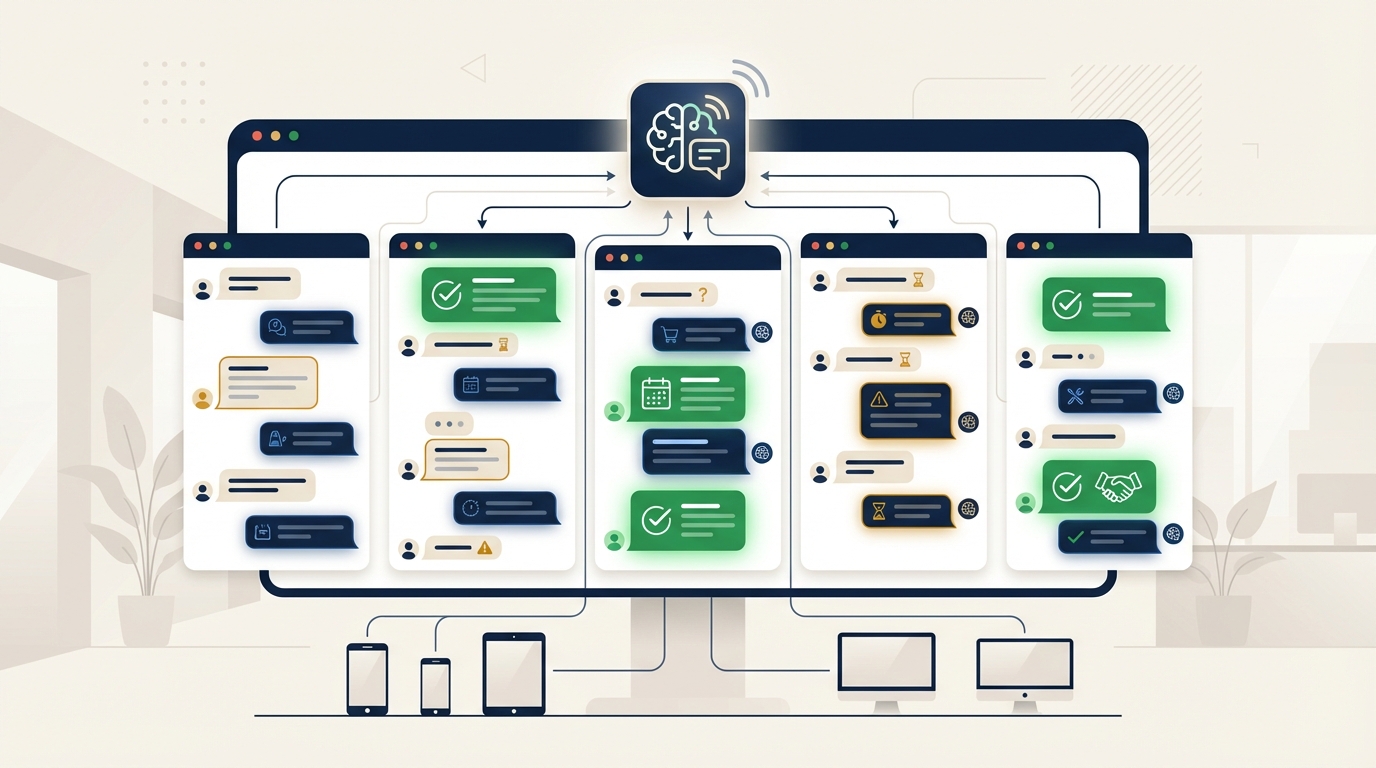
Modern AI chatbots are not the scripted decision trees of five years ago. Powered by large language models, today’s chatbots understand natural language, remember conversation context, and adapt their responses based on what the customer says.
For a service business, that means the chatbot can:
- Greet visitors and ask what they need help with
- Understand varied descriptions of problems (“my AC is blowing warm air” or “the heat pump stopped working”)
- Ask follow-up questions to qualify the lead
- Check calendar availability and book appointments
- Answer FAQs about pricing, service areas, and hours
- Collect contact information and route inquiries to the right person
- Handle multiple conversations simultaneously without degrading quality
According to IBM research, AI chatbots handle up to 80% of routine customer inquiries without human intervention. That aligns with what Salesforce found — organizations using AI chatbots achieve resolution rates of 96% with customer satisfaction scores of 97%.
Strengths
Always on. The chatbot never clocks out. Whether a customer reaches your website at 2 PM or 2 AM, they get the same instant response. For emergency service businesses — plumbing, HVAC, towing — this alone justifies the investment.
Scales instantly. During a summer heat wave, your HVAC business might get 50 website visitors in an hour. A chatbot handles all 50 simultaneously. A human team handles three at a time and leaves the other 47 waiting.
Consistent quality. Every customer gets the same thorough intake process. Every required question gets asked. No details fall through the cracks because an agent was tired or rushing between chats.
Cost efficient. At $0.50 per interaction versus $6.00 for a human agent, the math is straightforward. For a business handling 500 customer interactions per month, that is the difference between $250 and $3,000.
Limitations
Emotional intelligence has limits. A customer who is frustrated, upset, or dealing with a sensitive situation may not respond well to a chatbot — even a good one. Gartner’s 2024 survey found that 64% of customers would prefer companies not use AI for customer service, though that number is dropping as chatbot quality improves.
Complex problem-solving. When a conversation requires creative problem-solving, multi-step troubleshooting, or judgment calls about pricing and scope, human agents still outperform AI. The chatbot can capture the details, but a human may need to close the deal.
Initial setup investment. A chatbot needs to be configured with your business context — services, pricing, service area, scheduling rules. This takes time upfront, though most platforms make it manageable.
Live chat deep dive
What live chat delivers
Live chat connects customers with real people in real time. A trained agent reads the conversation, applies judgment, and responds with the full range of human communication — empathy, humor, reassurance, persuasion.
For service businesses, live chat means:
- A real person answering questions and building rapport
- Nuanced handling of complex or unusual requests
- Ability to negotiate pricing or upsell services naturally
- Emotional support for stressed or frustrated customers
- Human judgment for edge cases the AI has never seen
Hiver’s State of Customer Support Report found that 63% of customers still turn to live chat specifically when they need help from another person. There is a class of interactions where human presence genuinely matters.
Strengths
Empathy and rapport. When a customer is upset about a botched repair or anxious about a major expense, a human agent can read the emotional temperature and respond appropriately. This builds trust in ways that chatbots cannot fully replicate.
Closing complex sales. For high-value services — a full HVAC system replacement, a major renovation, a commercial contract — live chat agents can guide the conversation, address objections, and close the deal. The nuance required for these interactions exceeds what most chatbots deliver today.
Handling the unexpected. Customers occasionally bring questions that no FAQ covers. A human agent can improvise, consult colleagues, or escalate intelligently. A chatbot that hits the edge of its training either gives a generic response or hands off — and the handoff itself can frustrate customers.
Limitations
Expensive to scale. Staffing live chat requires hiring, training, and managing agents. For a small business, that often means outsourcing to a third-party service at $1,500 to $4,000+ per month depending on hours and volume. Extending to 24/7 coverage can double or triple the cost.
Inconsistent quality. Agent performance varies. A well-trained, experienced agent delivers great results. A new hire or a tired agent at the end of a long shift may not. Consistency is hard to maintain across a team.
Limited availability. Unless you pay for round-the-clock coverage, live chat goes offline after business hours. And as we covered in our post on why small businesses need an AI answering service, the majority of missed leads happen outside traditional business hours.
Does not scale with demand. Peak periods — a storm knocks out power for thousands, a viral social media post drives traffic to your site — overwhelm human teams. Wait times spike, customers leave, and those leads go to whoever responds first.
Head-to-head comparison
Cost
| Metric | AI chatbot | Live chat |
|---|---|---|
| Setup cost | $0-500 | $2,000-5,000 (hiring/training) |
| Monthly cost (SMB) | $50-200 | $1,500-4,000+ |
| Cost per interaction | ~$0.50 | ~$6.00 |
| Annual cost (500 interactions/mo) | $600-2,400 | $18,000-48,000 |
| Scales with volume? | Flat rate | Linear cost increase |
Winner: AI chatbot. The cost difference is not marginal — it is an order of magnitude. For a small business handling moderate volume, the annual savings range from $15,000 to $45,000. That is real money for a contractor, restaurant, or rental management company.
Speed
| Metric | AI chatbot | Live chat |
|---|---|---|
| First response time | Under 5 seconds | 1-5 minutes (average) |
| Peak hours response | Under 5 seconds | 5-15+ minutes |
| After-hours response | Under 5 seconds | Unavailable (unless 24/7 staffed) |
Winner: AI chatbot. Speed is where AI dominates without qualification. Research on lead response times shows that responding within five minutes makes you 21 times more likely to qualify a lead. AI guarantees that response time. Human teams cannot.
Quality and accuracy
| Metric | AI chatbot | Live chat |
|---|---|---|
| Consistency | Identical every time | Varies by agent |
| Handles routine inquiries | Excellent | Good (but overkill) |
| Handles complex inquiries | Adequate | Excellent |
| Emotional intelligence | Improving | Strong |
| Data capture accuracy | Near-perfect | Human error rate (~3-5%) |
Winner: Depends on the inquiry. For the 80% of conversations that are routine — scheduling, basic questions, lead qualification — AI chatbots match or exceed human quality with better consistency. For the 20% that require empathy, creativity, or complex judgment, humans still win.
Customer satisfaction
Zendesk’s 2026 report found that nearly 8 in 10 consumers say AI bots are helpful for simple issues, and 87% of people rate chatbot interactions as positive or neutral. Meanwhile, 68% of consumers believe chatbots should have the same expertise as skilled human agents — a bar that AI is rapidly approaching.
Winner: Tie. Customer satisfaction with AI chatbots has reached parity with live chat for routine interactions. For complex or emotional interactions, live chat still has an edge.
Real-world scenarios
Scenario 1: HVAC company during a heat wave
Situation: Temperatures hit 95 degrees and your phone and website light up with 40 inquiries in two hours. People need AC repairs, tune-ups, and new installations.
Best choice: AI chatbot. A human team of two agents handles six conversations at a time. The other 34 people wait — or leave. An AI chatbot handles all 40 simultaneously, qualifies each lead by urgency, and books appointments on your calendar. The most complex inquiries — full system replacements, commercial jobs — get flagged for human follow-up with all the context already captured.
Scenario 2: Vacation rental guest with a complaint
Situation: A guest at your rental property messages at 10 PM saying the hot water is not working. They are frustrated and considering leaving a negative review.
Best choice: Live chat (or hybrid). This conversation needs empathy. The guest is not looking for an FAQ answer — they want to know someone cares and is taking action. A human agent (or the business owner) can acknowledge the frustration, apologize, and coordinate a fix. That said, an AI chatbot can handle the initial response — “I’m sorry about that. Let me connect you with the property manager right away” — which is better than no response until morning.
Scenario 3: Plumber fielding after-hours inquiries
Situation: It is 11 PM on a Saturday. Three people contact your business: one has a burst pipe (emergency), one wants to schedule a faucet installation (routine), and one is asking about your service area (informational).
Best choice: AI chatbot. No live chat service is answering at 11 PM on a Saturday without premium pricing. An AI chatbot triages all three: it fast-tracks the emergency with an immediate notification to the on-call plumber, books the faucet installation for next week, and answers the service area question. All three customers get instant responses. Without the chatbot, all three get voicemail — and 80% of callers who reach voicemail hang up without leaving a message.
Scenario 4: Auto repair shop quoting a major repair
Situation: A customer’s vehicle needs $3,500 in engine work. They are chatting on your website, asking detailed questions about the repair, warranty, and payment options.
Best choice: Live chat. This is a high-value conversation that requires trust-building, technical explanation, and possibly negotiation. A human agent who understands the repair can walk the customer through the estimate, explain the warranty coverage, and offer a payment plan. An AI chatbot can capture the lead and schedule the consultation, but the close should be human. This is where having a dedicated solution like Torque AI for auto repair shops helps — it handles the routine inquiries so your team can focus on conversations like this one.
The hybrid approach: best of both worlds
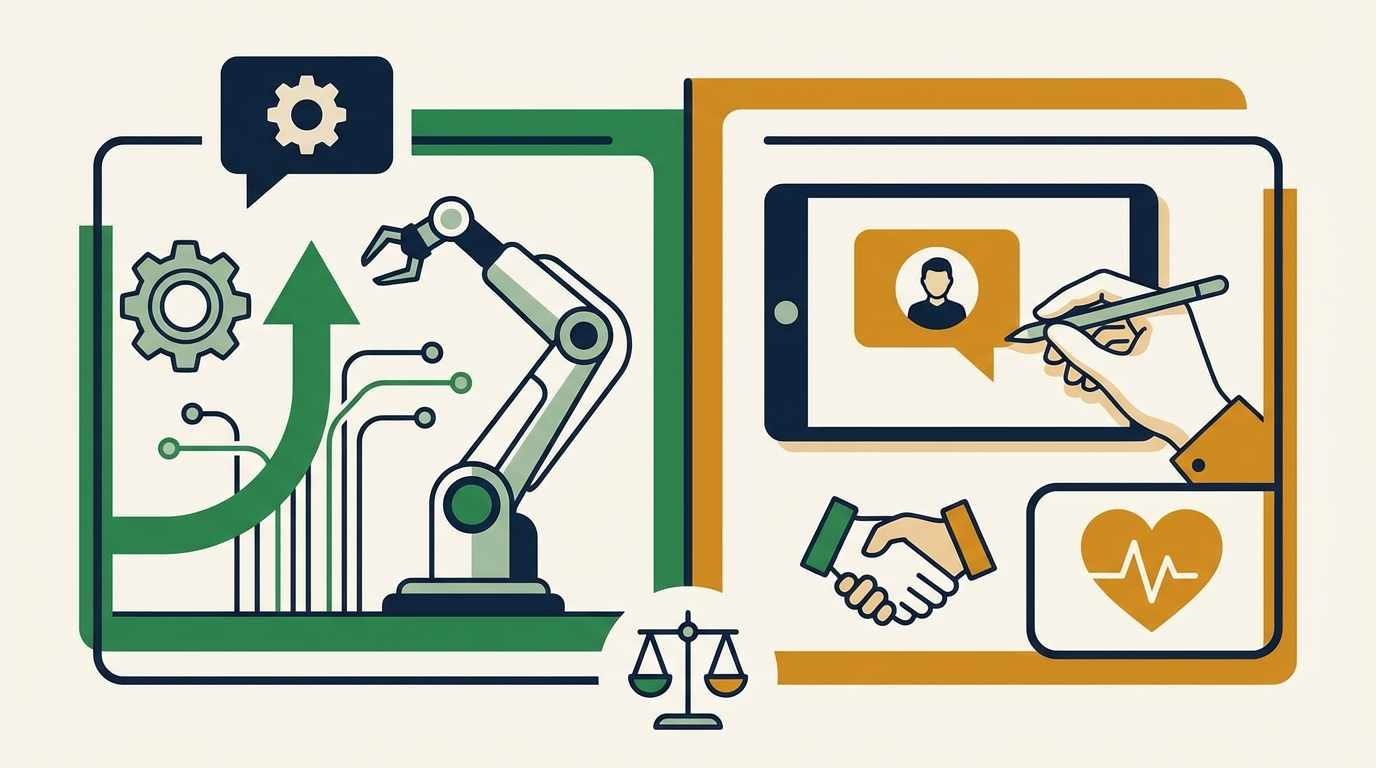
The data points to a clear conclusion: the best customer service setup is not AI or human — it is both.
Gartner’s research confirms this, recommending that service leaders prioritize “blending human strengths with AI intelligence” in 2026. Studies show that hybrid setups reduce customer complaints by 20%, increase retention by 10%, and cut support costs by up to 30%.
Here is how a hybrid approach works in practice:
- AI handles first contact. The chatbot greets every visitor, answers common questions, qualifies leads, and books appointments. This covers 80-90% of interactions.
- Complex conversations escalate to humans. When the AI detects frustration, a high-value opportunity, or a question beyond its scope, it hands off to a human — with the full conversation history so the customer never repeats themselves.
- Humans focus on what they do best. Instead of answering “What are your hours?” for the 50th time today, your team spends their time on revenue-generating conversations, complex problem-solving, and relationship-building.
This is the model behind Hollr. The AI intake widget handles the volume — the routine questions, the after-hours inquiries, the lead qualification — and surfaces only the conversations that genuinely need a human touch. For businesses that also need industry-specific AI, our AI Employees extend this further with agents trained for specific verticals.
The verdict
Choose an AI chatbot if:
- Your business handles high volumes of routine inquiries (scheduling, FAQs, lead intake)
- You need 24/7 coverage without 24/7 staffing costs
- You are a small team that cannot dedicate someone to monitoring live chat
- Your budget for customer communication is under $500/month
- Speed of response is your biggest competitive advantage
Choose live chat if:
- Most of your conversations involve high-value sales or complex negotiations
- Your customers frequently deal with emotionally charged situations
- You have the budget and team to staff it during peak hours
- Personal relationships are central to how you win and retain customers
Choose both if:
- You want the cost efficiency and availability of AI with the empathy and closing ability of humans
- You handle a mix of routine and complex inquiries
- You are ready to let AI handle the volume so your team can handle the value
Moving forward
The AI chatbot versus live chat debate is converging on a single answer: use both, and let each do what it does best. AI is better, faster, and cheaper for routine work. Humans are irreplaceable for the conversations that require judgment, empathy, and trust.
For service businesses across Appalachia, the practical path is clear. Start with an AI chatbot to capture every lead, answer every after-hours inquiry, and eliminate the dead time between a customer’s question and your response. Add human escalation for the conversations that deserve a personal touch.
If you want to see what this looks like in practice, explore how Hollr works for service businesses. It handles the first conversation so you can focus on the work that matters.