
AI Review Management: Turn Every Review into Growth
A one-star difference can mean a 9% swing in revenue
That is not a guess. A Harvard Business School study found that a one-star increase on Yelp translates to a 5–9% boost in revenue for independent restaurants. The effect is even stronger for businesses that lack the brand recognition of a national chain — which describes most businesses in the Appalachian region.
And consumers are pickier than ever. BrightLocal’s 2026 Local Consumer Review Survey found that 41% of consumers now always read reviews when browsing for a business, up from 29% just a year earlier. Nearly a third will only use a business with a 4.5-star rating or higher — almost double the 17% who held that standard in 2025.
AI review management gives small businesses a way to keep up with these rising expectations without hiring a dedicated marketing team. It handles the tedious parts — monitoring platforms, drafting responses, flagging issues — so you can focus on running your business while your reputation works for you.
Why reviews matter more than ever in 2026
Online reviews have always influenced buying decisions. What has changed is how much they influence discovery.
Reviews now feed AI search results
Generative AI tools like ChatGPT have gone from curiosity to mainstream recommendation engine. BrightLocal’s survey found that 45% of consumers now use AI tools for local business recommendations — up from just 6% last year. When someone asks an AI assistant for “the best plumber in Beckley,” the answer it generates pulls heavily from review content across Google, Yelp, and other platforms.
That means your reviews are not just influencing customers who read them directly. They are shaping how AI systems describe your business to people who never visit a review site at all.
Star ratings have become a hard filter
Consumers used to glance at star ratings. Now they use them as a cutoff. BrightLocal reports that 68% of consumers will only consider businesses with four or more stars, and 31% now require 4.5 stars or higher. If your business sits at 3.8 stars, you are invisible to a third of your potential customers before they read a single word of your reviews.
Response time expectations have shifted
It is no longer enough to respond to reviews eventually. 19% of consumers expect a response on the same day they post their review — up from 6% just one year ago. Another 32% expect a reply by the following day. And 89% of consumers expect businesses to respond to both positive and negative reviews.
For a shop owner who is under a truck all day or a restaurant manager running a Saturday dinner rush, checking and responding to reviews within hours is not realistic without help.
The review response problem
Most small businesses know reviews matter. The problem is not awareness — it is bandwidth.
Too many platforms, not enough hours
The average consumer now checks six different review platforms before choosing a business. That means your reviews are scattered across Google, Yelp, Facebook, Tripadvisor, Apple Maps, industry-specific sites, and now AI recommendation tools. Monitoring all of them manually takes time most small business owners do not have.
Templated responses hurt more than silence
Consumers are smart enough to notice when every review gets the same “Thank you for your feedback!” response. Generic replies signal that you are checking a box, not genuinely engaging. BrightLocal’s research notes that templated responses have a negative impact on consumer perception — in some cases, worse than no response at all.
Negative reviews require careful handling
A negative review demands a thoughtful, specific response that acknowledges the issue without being defensive. Writing that response well takes time and emotional composure — two things that are in short supply when you have just read someone calling your business incompetent on a public platform.
Get it wrong, and the response becomes a bigger problem than the review. Get it right, and you can actually turn a critic into a loyal customer. Research on customer retention shows that businesses responding within one hour achieve 71% customer retention versus 48% for those that take 24 hours.
How AI review management works
AI review management tools use natural language processing to do three things: monitor, respond, and analyze. Here is how each piece works.
Monitoring across platforms
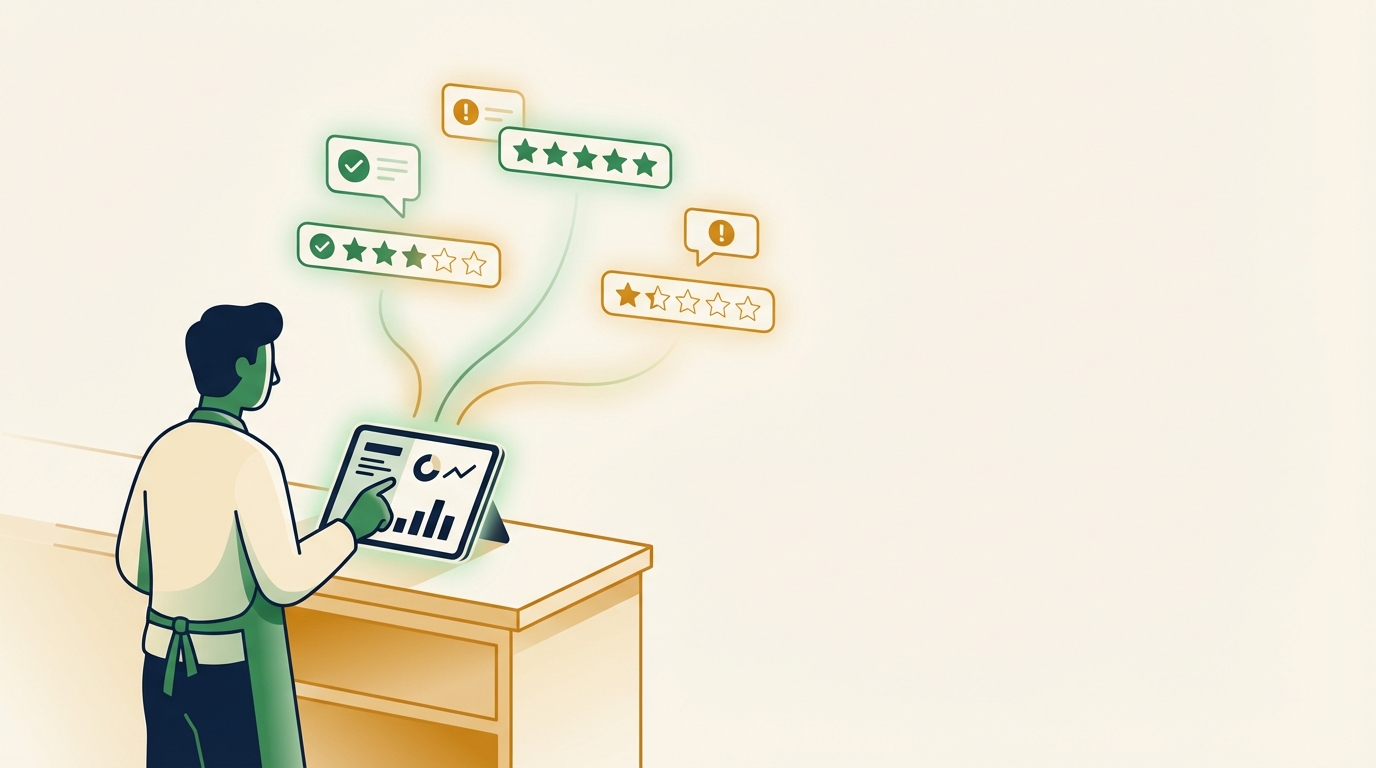
An AI review management system connects to your profiles on Google, Yelp, Facebook, and other platforms through their APIs. When a new review comes in on any platform, the system flags it immediately and classifies it by sentiment — positive, neutral, or negative. You see everything in one dashboard instead of checking six different apps.
Generating contextual responses
This is where the technology earns its keep. Instead of pasting the same template for every review, AI analyzes the specific content of each review and drafts a response that addresses what the customer actually said.
A five-star review mentioning your fast brake service gets a response that thanks the customer and references the brake work. A three-star review mentioning long wait times gets a response that acknowledges the delay and explains what you are doing to improve. The AI maintains your brand voice while tailoring every reply to the specific feedback.
Sentiment analysis and trend detection
Beyond responding to individual reviews, AI tools aggregate your review data to surface patterns. If three customers in the same month mention slow phone response, the system flags it as a trend — not just an isolated complaint. This turns your review stream from a firehose of opinions into structured business intelligence.
| Capability | Manual approach | AI-powered approach |
|---|---|---|
| Monitoring | Check 6+ platforms daily | Unified dashboard, instant alerts |
| Response time | Hours to days | Minutes |
| Response quality | Templated or inconsistent | Tailored to each review |
| Trend detection | Read every review individually | Automated sentiment analysis |
| Scalability | 1-2 hours/day for 20+ reviews | Set rules, review exceptions |
Five Star AI — automated responses that feel personal
At Appalach.AI, we built Five Star AI specifically for small businesses that need review management without the enterprise price tag or complexity.
Five Star AI works as your dedicated review management employee. It monitors your Google and Facebook profiles continuously, drafts personalized responses based on the actual content of each review, and posts them according to rules you control. You can set it to auto-publish responses for four- and five-star reviews while routing negative reviews to you for approval before posting.
The system learns your brand voice from your existing responses and adapts over time. A mountain resort in the New River Gorge area gets responses that sound different from an auto repair shop in Huntington — because they should.
What Five Star AI handles
- Positive reviews: Acknowledges the specific experience mentioned, reinforces what the customer enjoyed, and invites them back
- Neutral reviews: Addresses any concerns while highlighting positives, offers to follow up
- Negative reviews: Empathetic acknowledgment, specific response to the complaint, invitation to resolve offline — then routes to you for approval before posting
- Review solicitation: Sends timed follow-up messages to recent customers with a direct link to leave a Google review, following Google’s official guidelines for compliant review requests
Mining reviews for business insights
Responding to reviews is the defensive play. The offensive play is using review data to improve your business.
Identifying operational gaps
When AI aggregates hundreds of reviews across months, patterns emerge that you would never catch reading reviews one at a time. Common themes show up as clear signals:
- Multiple mentions of “wait time” or “scheduling” point to a booking process problem
- Repeated praise for a specific employee tells you who deserves recognition — and whose methods should be replicated
- Seasonal patterns in complaint types reveal when you need extra staffing or adjusted hours
Competitive intelligence
AI tools can also monitor your competitors’ reviews. If the auto shop across town is getting consistent complaints about pricing transparency, that is an opportunity for you to emphasize upfront estimates in your own marketing and review responses.
Tracking improvement over time
Once you make changes based on review feedback, AI tracks whether the sentiment shifts. If you added online booking after customers complained about phone wait times, you can measure whether booking-related complaints actually decrease in the following months.
This is the same data that enterprise companies pay consultants thousands of dollars to extract from customer feedback surveys. For a small business, it is sitting right there in your reviews — you just need a tool that can read it at scale.
Building a review generation strategy
Having great AI review management means nothing if you do not have reviews coming in. Fresh reviews matter — BrightLocal found that 22% of consumers only pay attention to reviews written in the past two weeks.
Ask at the right moment
The best time to ask for a review is immediately after a positive interaction — when the customer’s car is running smoothly, when the HVAC system is blowing cold air again, when the vacation rental exceeded expectations. Automated follow-up messages sent within 24 hours of service completion consistently generate the highest response rates.
Make it frictionless
Every extra step reduces the likelihood of getting a review. Send a direct link to your Google review page — not a link to your website with instructions on how to find the review form. QR codes printed on receipts or service invoices work especially well for in-person businesses.
Follow Google’s rules
Google’s review policies have tightened significantly in 2025 and 2026. Review gating — asking only happy customers to leave public reviews — is explicitly prohibited. Offering discounts or incentives for reviews violates their terms. And Google’s AI detection now flags review patterns that look manufactured, with penalties ranging from review removal to profile suspension.
The sustainable approach is simple: deliver good service, ask every customer to share their experience, and respond to every review — good or bad. AI handles the last part at scale.
The bottom line
Reviews are not just a vanity metric. They directly influence whether customers find you, trust you, and choose you over the competition. With consumer expectations rising sharply — higher star requirements, faster response demands, more platforms to monitor — manual review management is no longer sustainable for most small businesses.
AI review management tools close that gap. They give you the ability to respond to every review quickly and personally, surface the insights hidden in your feedback, and build a steady stream of fresh reviews that keep your business visible in both traditional search and AI-powered recommendations.
If your business depends on local customers finding and trusting you — and in Appalachia, whose does not — your review strategy deserves the same attention as your service quality. Explore how Five Star AI can manage your reputation, or get in touch to talk about the right approach for your business.