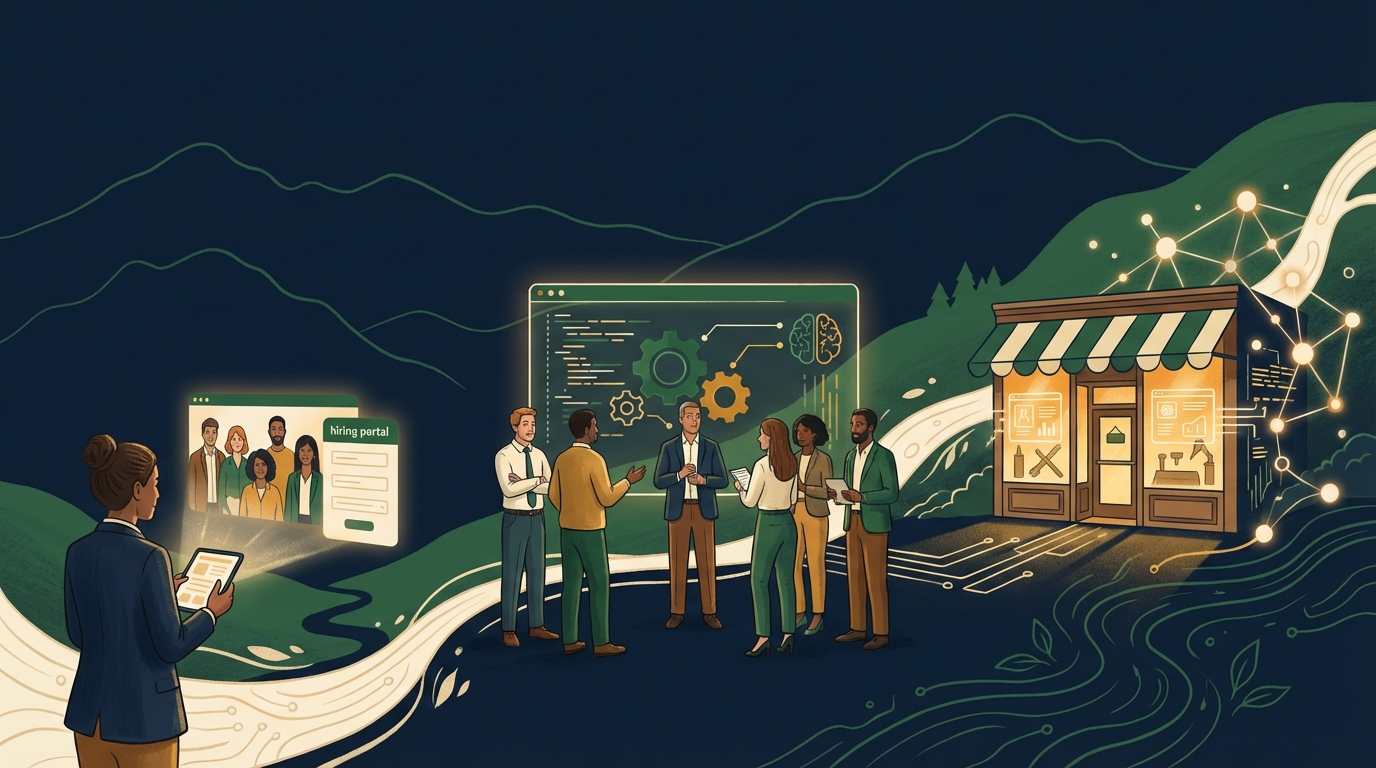
AI isn't killing jobs — but it is changing who you hire
The headlines don’t match the data
Nearly 40% of American workers now fear losing their jobs to AI — up from 28% just two years ago. The anxiety is real. But the actual labor numbers tell a different story: 77% of businesses using AI report growing their workforce, not shrinking it.
That gap between fear and reality matters for every small business owner trying to figure out whether AI is a threat or an opportunity. The short answer: it depends on what kind of work you’re talking about.
What the labor data actually says
The U.S. economy has added jobs since the AI boom began in late 2022. Total employment grew 2.5% in that period. But the growth isn’t evenly distributed, and the details reveal a clear pattern.
AI is reshaping tasks, not eliminating jobs
The most important finding across multiple studies: AI automates specific tasks within a job, not entire positions. A restaurant manager’s scheduling work can be handled by AI, but the judgment calls about staffing a holiday weekend still require a human. A contractor’s dispatch routing can be automated, but reading a customer’s tone on a callback takes experience.
Research from the Dallas Federal Reserve frames this as the difference between codifiable knowledge (textbook learning that AI handles well) and tacit knowledge (experience-based judgment that AI cannot replicate). The practical result: AI substitutes for routine work but amplifies the value of experienced workers.
Entry-level roles face the most pressure
Here’s where the data gets uncomfortable. In jobs with high AI exposure, employment for workers aged 22 to 25 fell 6% between late 2022 and mid-2025. Workers over 30 in those same fields saw employment grow 6% to 13%.
Entry-level tech postings have been hit hardest. Some analyses show a 67% decrease in U.S. entry-level tech job postings between 2023 and 2024. The tasks that junior developers and content writers used to cut their teeth on — boilerplate code, data entry, basic drafts — are exactly the tasks AI handles fastest.
AI-related job postings are surging
While overall job postings sit just 6% above pre-pandemic levels, postings that mention AI or AI-related skills have surged more than 130% over the same period. Employers aren’t hiring fewer people — they’re hiring different people.
Workers with AI skills now command wage premiums up to 56% higher than peers in equivalent roles. That premium holds across industries, not just tech.
Why this matters for small businesses
If you run a small business in Appalachia, this data points to three practical realities.
First, AI won’t replace your team — but it will change what they do. The plumber who answers phones, schedules jobs, and handles follow-ups doesn’t disappear. But the phone answering and scheduling parts of that job can run on AI, freeing the person to focus on customer relationships and the skilled work that actually generates revenue.
Second, the workers you hire next should know how to work alongside AI. This doesn’t mean everyone needs to code. It means the person you hire for office management should be comfortable using AI tools for scheduling, email triage, and data entry rather than doing those tasks manually.
Third, you don’t need to hire for every gap AI can fill. Small businesses often can’t afford specialists. That’s precisely where AI employees fill the gap — handling dispatch, review management, customer intake, and other repeatable tasks that would otherwise require additional headcount you can’t justify.
Our take
The “AI is coming for your job” narrative sells clicks. The reality is messier and more useful: AI is coming for your tasks. Some of those tasks are the boring ones nobody wants to do anyway. Others are the entry-level tasks that used to be how new workers learned the ropes.
The bottom line: Small businesses that pair AI tools with experienced staff will outperform those that try to replace people entirely or those that ignore AI altogether.
The most encouraging signal comes from IBM, which is tripling its entry-level hiring in 2026 — not despite AI, but because of it. Their reasoning: companies that invest in human talent alongside AI now will have the strongest teams in three to five years. The same logic applies to a 10-person contracting company or a family restaurant.
What’s missing from the conversation
Most of the job impact research focuses on large enterprises and tech companies. Small businesses — especially rural ones — operate differently. A five-person shop doesn’t have entry-level roles to cut. They have overworked owners doing three jobs at once. For them, AI isn’t about replacing staff. It’s about finally getting help with the tasks that pile up after closing time.
What you should do
Immediate actions
-
Audit your repetitive tasks. List everything your team does that follows a predictable pattern: answering common questions, scheduling, sending reminders, sorting emails. Those are your highest-ROI automation targets.
-
Start with one AI tool, not five. If you’re fielding calls after hours, an AI answering service pays for itself fast. If scheduling eats your mornings, a dispatch tool like Dispatch AI is a better starting point than a full AI overhaul.
-
Upskill your current team. The World Economic Forum projects that 39% of today’s skills will become outdated by 2030. Invest a few hours per month helping your existing employees learn the AI tools relevant to their roles. It’s cheaper than hiring and builds loyalty.
Watch for
- State-level AI workforce programs. Federal funding is flowing into AI training consortiums. West Virginia and neighboring states may launch programs to help small businesses adopt AI — watch your local SBDC and chamber of commerce announcements.
- AI skills on resumes. When you do hire, candidates with even basic AI tool experience will save you onboarding time and bring fresh efficiency ideas.
The path forward
AI is not the job-killer the headlines suggest, and it’s not the magic solution that replaces your need for good people. It’s a tool — one that works best when paired with the experience and judgment that only humans bring.
For small businesses in Appalachia, the opportunity is straightforward: use AI to handle the work that keeps you up at night so your team can focus on the work that keeps customers coming back. If you’re not sure where to start, we wrote a practical guide on when to automate and when to hire that breaks down the decision for each role in your business.
Ready to see what AI can handle for your business? Explore AI Employees — purpose-built agents for the tasks small businesses deal with every day.