
AI for Auto Repair Shops: From Estimates to Reviews
Your phone is ringing and your hands are covered in oil
You are underneath a truck replacing a CV axle when the shop phone starts ringing. Your service writer is already on another call. The customer on hold gives up after 40 seconds and calls the shop down the street.
That scenario plays out thousands of times a day across the auto repair industry. The automotive sector has a 23% unanswered call rate — nearly one in four potential customers can’t reach a shop when they need service. For a typical 6-bay shop averaging $450 per repair order, missing just 40 calls a month means $18,000 in potential lost revenue.
AI for auto repair shops is not about replacing mechanics with robots. It is about handling the business side — answering phones, booking appointments, following up on estimates, and managing reviews — so you can focus on the work that actually earns money.
The U.S. auto care industry hit $414 billion in 2024 and is growing at 5.1% annually. Independent shops handle 75% of all aftermarket repair work. But most of those shops still run their front office on a landline phone, a paper calendar, and hope. There is a better way.
The state of auto repair in 2026
The industry is caught between rising demand and a shrinking workforce.
The Bureau of Labor Statistics projects 70,000 job openings per year for automotive service technicians through 2034. Most of those openings come from retirements, not growth — experienced mechanics are leaving faster than new ones are entering the trade. The average repair order value has climbed to $428 in 2025, which means every missed appointment hurts more than it used to.
Meanwhile, vehicles are getting more complex. Electric and hybrid vehicles require specialized knowledge in battery systems and power electronics. The J.D. Power 2025 Customer Service Index Study found that 12% of repairs are not completed correctly on the first visit, with EV service satisfaction lagging significantly behind traditional vehicles.
For shop owners in the Appalachian region, these pressures stack on top of the usual challenges: smaller customer bases, longer drive distances, and fewer qualified technicians willing to work in rural markets. AI tools help level the playing field by automating the administrative work that eats into your productive hours.
AI appointment booking — reduce no-shows by 40%
The problem
Appointment scheduling is where most shops lose money before the wrench even turns. Between phone tag, no-shows, and the morning Monday rush, the front desk becomes a bottleneck.
Research from Numa shows that over half of all appointment calls come in Monday and Tuesday mornings, with the heaviest volume between 8 and 11:30 AM. That is also when your service writer is checking in vehicles, writing up estimates, and handling the customers standing at the counter. Something has to give, and it is usually the phone.
No-shows compound the problem. The industry average sits between 10% and 20% for auto repair appointments. At $400 per repair order, a shop running 25 appointments a day loses $400 to $2,000 every day to customers who simply don’t show up.
How AI fixes it
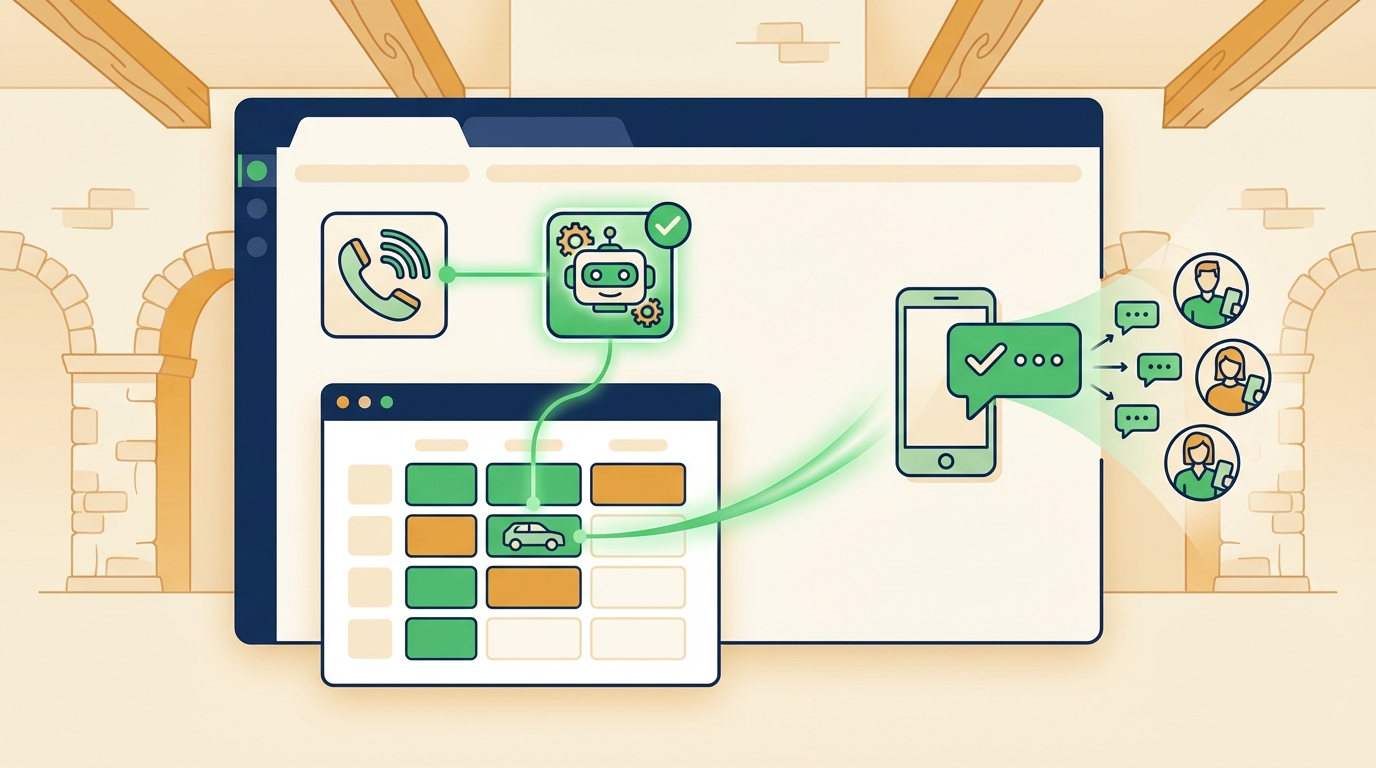
AI appointment booking answers every call — including the ones that come in at 7 PM when your check engine light turns on during the commute home. The system handles the conversation naturally, asks about the vehicle and the problem, checks your schedule, and books the appointment. The customer gets a confirmation text immediately.
From there, automated reminders go out before the appointment — typically a text the evening before and another one hour prior. Shops using automated reminders cut no-show rates from 20% down to under 5%. On a 25-appointment day, that is the difference between losing four customers and losing one.
The AI also handles rescheduling. When a customer texts back “Can we move to Thursday?” the system checks availability and rebooks without anyone at the shop touching the phone.
What this looks like in practice
Picture a two-bay shop in Morgantown. The owner is also the lead mechanic. Before AI booking, he was answering calls between oil changes — sometimes forgetting to write down the details, sometimes losing the customer entirely. After setting up an AI answering system, his after-hours bookings increased by 15 appointments per month. At an average ticket of $380, that is $5,700 in monthly revenue that was previously going to voicemail.
Automated estimate follow-ups — convert more quotes to jobs
The problem
Every shop owner knows the frustration: you spend 30 minutes diagnosing a vehicle, write up a detailed estimate, call the customer — and hear nothing back. The estimate sits in your system collecting dust.
The conversion rate on estimates varies widely, but most independent shops convert between 50% and 70% of their quotes. That means 30% to 50% of the diagnostic work you do generates zero revenue. For a shop that writes 15 estimates a day, five to eight of those customers are deciding whether to come back — and a timely follow-up is often the deciding factor.
How AI fixes it
AI follow-up systems track every open estimate and send personalized reminders at the right intervals. Not a generic “your estimate is ready” email — a message that references the specific vehicle, the recommended repairs, and a clear next step.
The sequence typically works like this:
- Same day — A text confirming the estimate was sent, with a link to view it online
- Day two — A follow-up asking if the customer has questions about any of the recommended services
- Day five — A final reminder noting that the parts quote may expire soon and offering to reschedule at the customer’s convenience
The AI adjusts based on the response. If the customer replies “too expensive,” the system can offer a priority repair plan — fixing the safety-critical items first and scheduling the rest over time. If the customer asks a question, it routes the conversation to your service writer with the full context.
The revenue impact
A shop converting 55% of estimates that starts recovering even 10% of the lost quotes sees meaningful results. On 15 daily estimates at $400 average, recovering 1.5 additional jobs per day adds $600 in daily revenue — or roughly $156,000 annually. The AI costs a fraction of that.
Follow-ups also build trust. When a customer sees that you remembered their 2018 F-150 needs new brake rotors, it signals that you are paying attention. That matters in small communities where reputation drives referrals.
AI-powered review management — build trust at scale
Why reviews matter for auto repair
Trust is the foundation of the auto repair business. A customer is handing you the keys to a machine they depend on every day. They want to know you are honest, competent, and fair.
Online reviews are how new customers make that judgment. 97% of consumers read online reviews when browsing local businesses, and 82% expect repair shops to have at least a four-star rating. A one-star increase in your rating can lead to a 5% to 10% increase in revenue.
The flip side is damaging: 94% of consumers will avoid a business after reading negative reviews. And more than three-quarters of callers will immediately try another shop when they see a low rating on Google.
How AI review management works
AI review tools monitor Google, Facebook, Yelp, and other platforms in one place. When a new review comes in, the system drafts a response within minutes — not a canned template, but a reply that addresses the specific feedback the customer left.
For positive reviews, the response thanks the customer and mentions something specific from their visit. For negative reviews, the response acknowledges the concern, offers to make it right, and takes the conversation offline. The shop owner reviews and approves before anything posts — you stay in control, but you don’t have to write every word from scratch.
The system also handles the other side of the equation: asking for reviews. 76% of customers who are asked to leave a review actually do it. The AI sends a review request via text after each completed job, timed to arrive when the customer is most likely to respond — typically a few hours after pickup.
Building a review flywheel
For shops in Appalachian markets, reviews are especially powerful. In smaller towns, a shop with 200 Google reviews and a 4.8 rating dominates local search results. Your competitor with 15 reviews and no responses is invisible by comparison.
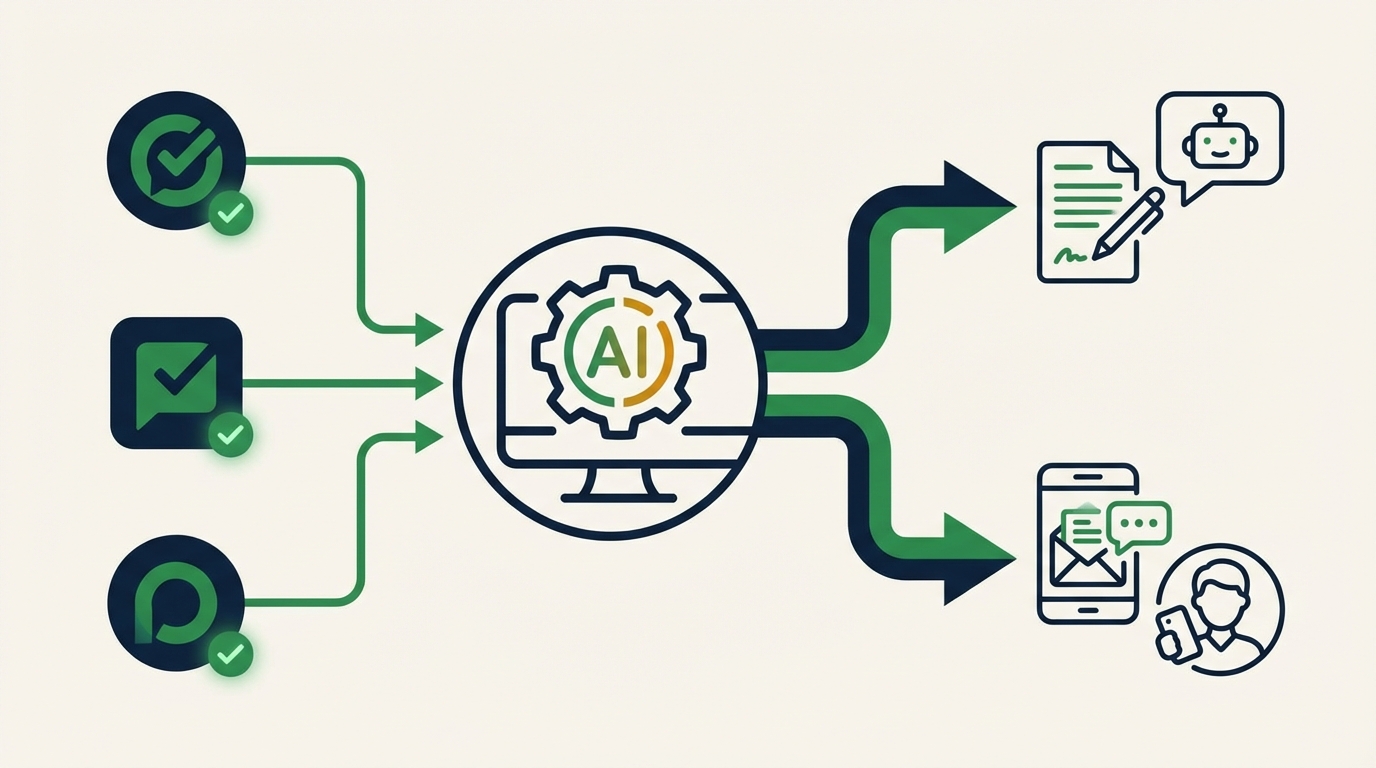
Five Star AI automates this entire cycle — monitoring platforms, drafting responses, requesting reviews, and flagging issues that need your personal attention. It turns review management from a task you never get to into a system that runs itself.
Getting started with AI for your shop
You do not need to overhaul your entire operation overnight. The most successful shops start with one problem and one tool.
Pick your biggest pain point
- Missing calls and losing leads? Start with AI appointment booking. This has the fastest ROI because it directly captures revenue you are currently losing.
- Estimates gathering dust? Start with automated follow-ups. The revenue is already in your pipeline — you just need to convert it.
- Thin online reputation? Start with AI review management. This compounds over time and pays off for years.
What to look for in an AI tool
Not every tool is built for independent shops. The right solution should:
- Work with your existing systems — Your shop management software, phone system, and calendar should connect without a complete rebuild
- Handle the conversation naturally — Customers should feel like they are talking to a knowledgeable service advisor, not fighting a phone menu
- Give you control — You should approve responses, set business rules, and override the AI when needed
- Price for a small business — Enterprise software priced for dealership chains does not help a 3-bay shop in Beckley
A practical first month
- Week one: Set up AI call handling for after-hours and overflow calls. Let your service writer handle daytime calls while the AI catches everything else.
- Week two: Review the call transcripts and adjust. Notice what questions customers ask and make sure the AI handles them well.
- Week three: Add automated appointment reminders. Watch your no-show rate start dropping.
- Week four: Turn on estimate follow-ups for any quote older than 48 hours. Track how many convert.
Torque AI is built specifically for auto repair shops — handling appointment booking, estimate follow-ups, and customer communication through the channels your customers already use. It learns your shop’s services, pricing, and schedule so it can answer questions the way your best service writer would.
If you are already drowning in calls during the Monday morning rush, that is the problem AI was made to solve. The shops that figure this out first will capture the customers that their competitors keep sending to voicemail.
See how Torque AI works for auto repair shops and start with the calls you are missing right now.