
Gemini Nano Banana: Brand-Consistent AI Images for SMBs
The “image of my dream home” moment for small business
Google quietly shipped the most useful small business marketing feature of the year in April. Inside the 10th edition of Gemini Drops, the company added Nano Banana image generation to Personal Intelligence — meaning Gemini can now create images that already understand your brand, your team, your products, and the look you have been trying to describe to a designer for a year.
For an HVAC shop in Beckley or a bakery in Boone, the practical change is simple: you can stop typing “generate a clean white service van in a snowy West Virginia driveway, with the company logo on the side door, in the same warm photographic style we used last season” and instead just say “generate a hero image for our snow-storm callout post.” Gemini already knows what your van looks like, what colors you use, and what tone your past posts struck. That is the Gemini Nano Banana small business pitch in one sentence.
This is a news-reaction post, not a deep dive. Below is what Google actually shipped, why brand-consistent AI images matter more than people realize for a small business, how it stacks up against ChatGPT’s competing release, and a 30-minute workflow you can run this week.
What Nano Banana and Personal Intelligence actually do
Two features rolled out together in April 2026, per Google’s blog and TechCrunch’s coverage.
Nano Banana is Google’s nickname for the Gemini 3 Pro Image model — the same image engine the company uses on its premium Workspace tier. It went from gated paid feature to a default capability inside the Gemini app for AI Plus, Pro, and Ultra subscribers in the U.S. The EEA, Switzerland, and the UK were excluded at launch. Pricing for AI Plus is $19.99 per month; the Pro tier sits at $19.99 and Ultra at $124.99.
Personal Intelligence is the connective tissue. With your permission, Gemini can pull context from Gmail, Google Calendar, Google Photos, and Google Drive to ground its responses in your actual life and business. When you combine that with image generation, Gemini stops guessing what “our family at the cabin” means and starts generating an image of the actual people, the actual cabin, in the actual style of photo you have taken before.
The headline use cases Google demoed:
- Personalized image generation. Instead of “design my dream home, my interests are tennis and music,” you say “design my dream home” and Gemini fills in the rest from context it already has.
- Group-aware prompts. Gemini reads Google Photos labels — “Family,” “Crew,” “Event 2025” — so a prompt like “generate an image of my crew at the new shop” pulls the right faces into the right setting.
- Reference-aware editing. Upload a product photo, ask for it in three different scenes, get three on-brand variations rather than three generic riffs.
The upgrade is less about raw image quality — Nano Banana was already strong on the Image Arena Leaderboard — and more about removing the prompt-engineering tax. For a small business owner who never wanted to learn how to write a 200-token prompt with negative keywords and reference weights, that tax was the real barrier.
Why brand-consistent AI images matter for small business
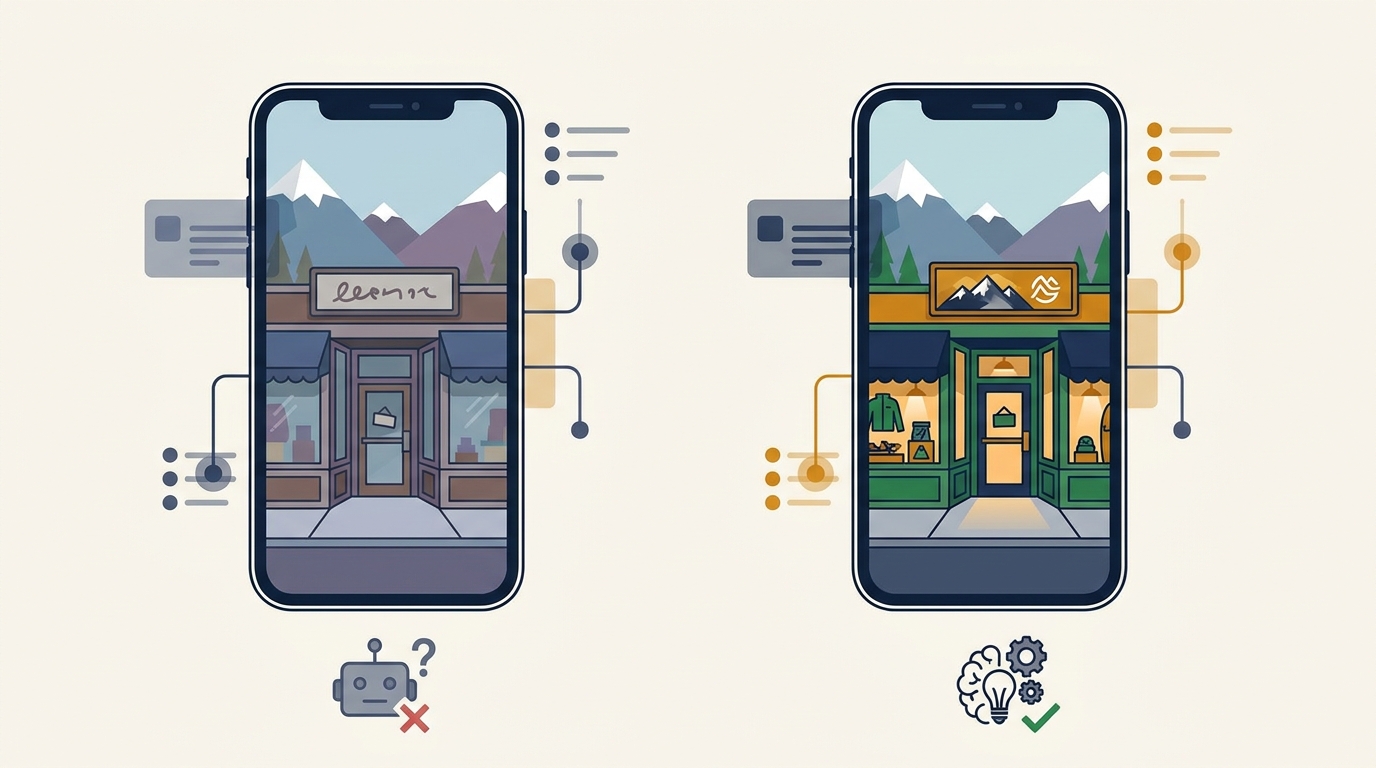
Most AI image tools fail small businesses on consistency, not quality. A coffee roaster can generate a beautiful image of beans tumbling out of a hopper. They can generate it again next week. The problem is the second image looks nothing like the first — different lighting, different mug, different counter, different mood. That works fine for a one-off blog hero. It does not work for a brand.
Three reasons consistency is the real unlock:
Recognizability beats novelty in feed. Instagram, Facebook, and Google Business Profile posts compete in fast-scrolling feeds where viewers spend around 1.7 seconds per post on mobile according to Meta’s own research. The brain pattern-matches before it reads. A unified visual style across ten posts works harder than ten beautiful but unrelated images.
Brand equity is the small business moat. A solo plumber competing with five other shops cannot win on price or scale. They win on being the recognizable, trusted, local name. Visual consistency — same colors, same vibe, same human face when there is one — is how that recognition compounds over time. Every off-brand post resets the clock.
Designer time is the bottleneck. Most small businesses cannot afford a part-time designer, much less a full-time one. The 2026 SBE Council Small Business Tech Use Survey put 82% of small business employers as already investing in AI tools — and content creation was one of the top three use cases. The bottleneck has moved from “can we afford to make this?” to “can we make this on-brand without a human in the loop?”
Nano Banana with Personal Intelligence answers that last question better than any consumer AI tool to date. The model already has a feel for your photo library, the style you tend to keep, the people who actually work at your business. The output drifts less. That matters more than another two points of arena ranking.
How this stacks up against ChatGPT image generation
OpenAI shipped its own answer five days later. ChatGPT Images 2.0 launched on April 21, 2026 and is also strong — it is genuinely better at rendering legible text inside a graphic, which matters for menus, sale signs, and price tags. DALL-E 3 retires May 12, 2026.
A practical small business comparison as of early May 2026:
| Capability | Gemini Nano Banana (Personal Intelligence) | ChatGPT Images 2.0 |
|---|---|---|
| Brand consistency from your own data | Yes — pulls from Gmail, Photos, Drive | Limited — needs manual reference uploads each time |
| Text rendering inside images | Good | Better (95%+ accuracy on headlines and prices) |
| Image quality on basic scenes | Top-tier | Top-tier |
| Free tier | None for Personal Intelligence (AI Plus minimum) | Yes, throttled |
| Paid entry tier | $19.99 / month (AI Plus or Pro) | $20 / month (ChatGPT Plus) |
| EEA / UK availability | Excluded at launch | Available |
The honest read: if your priority is making graphics with sharp text — a sandwich-board menu, a sale flyer, a price callout — ChatGPT Images 2.0 is the better tool today. If your priority is making a steady stream of on-brand photos and lifestyle imagery for social, blog, and Google Business Profile posts, Gemini’s Personal Intelligence wins because it does the brand work for you.
For most small businesses, those are different jobs and you may end up using both. The economics are not punishing — combined, both tools are about $40 per month, less than two hours of a freelance designer’s time.
If you want a deeper teardown of the ChatGPT side, we covered the broader OpenAI direction in our piece on the Workspace Agents launch and the GPT-5.4 Mini and Nano models. Both shape what ChatGPT Images 2.0 is competing on.
A simple workflow to use Nano Banana this week
Don’t build a strategy. Run a 30-minute pilot. Here is the smallest useful test for a service business, restaurant, or retail shop.
- Subscribe to Google AI Plus or Pro for one month. $19.99 buys you the full Personal Intelligence + Nano Banana feature set. You can cancel after the pilot if it does not pay off.
- Connect Google Photos to Gemini. This is the single most important step. Without Photos access, you lose the brand-consistency advantage and you are using a more expensive version of the free Nano Banana. Inside the Gemini app, go to settings and toggle on Personal Intelligence with Photos and Gmail.
- Label your reference photos. Tag your storefront, your team, your hero product, and your most-used backgrounds in Google Photos. Use specific labels — “Storefront 2025,” “Crew,” “Best Sellers.” Gemini reads those labels.
- Generate three pilot images. Try three prompts against your real upcoming content calendar:
- “An on-brand hero image for a Memorial Day sale post.”
- “A clean photo of [your product] on the workbench in our shop.”
- “An image of our crew at the front of the storefront, golden hour.”
- Compare each to a generic Nano Banana generation. Open a separate prompt without Personal Intelligence enabled, run the same three. The contrast tells you how much value the personalization layer is actually adding for your business.
- Publish one to your Google Business Profile, one to Instagram, and one to a blog post. Track which one drives the most engagement over a week. That is your signal for which formats reward AI imagery in your market.
The mistake to avoid: trying to make Gemini produce one perfect hero image for the homepage. That is the slowest, hardest job for any AI tool. The right job is the steady-cadence work — weekly social, monthly newsletter, Google Business Profile posts, blog hero images — where consistency and speed beat any single masterpiece.
If image generation is the marketing layer, the writing layer still has to keep up. Our Content Forge tool handles the long-form blog and structured social copy that should accompany each visual. Posts with on-brand images and well-targeted copy compound; posts with one but not the other stall.
What to watch over the next quarter
A few signals worth tracking as Personal Intelligence and Nano Banana mature:
- Whether Google extends Personal Intelligence to free Gemini accounts. Right now it is gated to AI Plus and above. If Google opens it up to compete with ChatGPT’s free tier, the per-image cost for small businesses goes effectively to zero.
- EEA, UK, and Switzerland availability. Google excluded these markets at launch over data-handling concerns. A rollout there expands the addressable market and pressures regional alternatives.
- Whether ChatGPT ships a Gmail and Photos equivalent. OpenAI’s Workspace Agents launch hinted at deeper data integration. If ChatGPT Images 2.0 gains Personal-Intelligence-style context, the brand-consistency advantage shrinks.
- The point at which freelance designers reposition. Designers who treat AI image tools as a competitor will lose. Designers who use them as a fast first-draft engine and charge for taste, brand strategy, and final-mile polish are about to get more profitable, not less.
The bottom line
Brand-consistent AI image generation is the single feature that turns AI imagery from a novelty into a marketing system for a small business. Gemini Nano Banana inside Personal Intelligence is the first consumer tool to ship it credibly, and the pricing is small-business friendly. Pair it with a tool like ChatGPT Images 2.0 for text-heavy graphics and you have, for under $40 a month, the visual content engine that used to require a part-time designer.
If you want help wiring AI image and copy generation into a content rhythm that actually runs every week without a designer or a writer on payroll, get in touch. We help small businesses across Appalachia build content operations that hold up over time, not one-off campaigns that stall after the launch.