
Local SEO for WV Businesses: The Complete 2026 Guide
98% of your customers search online before they call
That is not a projection. According to BrightLocal’s 2026 Local Consumer Review Survey, 98% of consumers now search online for local businesses. Eighty percent search weekly. And when they search, 72% go straight to Google.
For a plumber in Parkersburg, a restaurant in Lewisburg, or a cabin rental near the New River Gorge, that means your Google presence is your storefront. If you do not show up when someone searches “HVAC repair near me” or “best pizza in Morgantown,” you are invisible to the people most ready to spend money.
Local SEO for West Virginia businesses is not optional anymore. It is the difference between a full schedule and an empty one. This guide covers everything you need to know — from optimizing your Google Business Profile to managing reviews, building citations, and preparing for the AI-powered search features that are reshaping how customers find local businesses.
Why local SEO matters more in rural markets
In dense urban markets, businesses compete with hundreds of competitors for the same keywords. In West Virginia’s smaller markets, the competition is thinner — but so is the margin for error. A handful of well-optimized competitors can lock up the entire first page of Google for your service area.
The local pack decides who gets the call
When someone searches for a local service, Google shows a three-pack of business listings above the regular search results. These listings get 126% more traffic and 93% more actions — calls, directions, website visits — than businesses ranked below them. If you are not in that top three, you are fighting over scraps.
For West Virginia businesses, the math is stark. Many local markets have just four or five competitors for a given service. If three of them optimize for local search and you do not, you are effectively giving them your customers.
Broadband is catching up — and so are your competitors
West Virginia has historically ranked near the bottom nationally for internet access. The state currently ranks 46th in broadband coverage, and roughly 30% of residents still cannot purchase a plan meeting basic speed thresholds.
But that is changing fast. West Virginia received $1.2 billion in BEAD funding through the Infrastructure Investment and Jobs Act, with deployment already underway across rural counties. Governor Morrisey announced $34.6 million in fiber grants covering ten rural counties, and a $25 million middle-mile project is expanding coverage across southern West Virginia.
As broadband reaches more communities, more of your potential customers are searching online — and more of your competitors are establishing a digital presence. The window to be the first well-optimized business in your market is narrowing.
Google Business Profile: your most important asset
Your Google Business Profile (GBP) is the single most important factor in local search visibility. According to the 2026 Local Search Ranking Factors survey, GBP signals are the top-weighted category for local pack rankings.
Customers are 2.7 times more likely to trust a business with a complete Google Business Profile. Fully optimized profiles are visible 80% more often in search results and generate four times more website visits than incomplete ones.
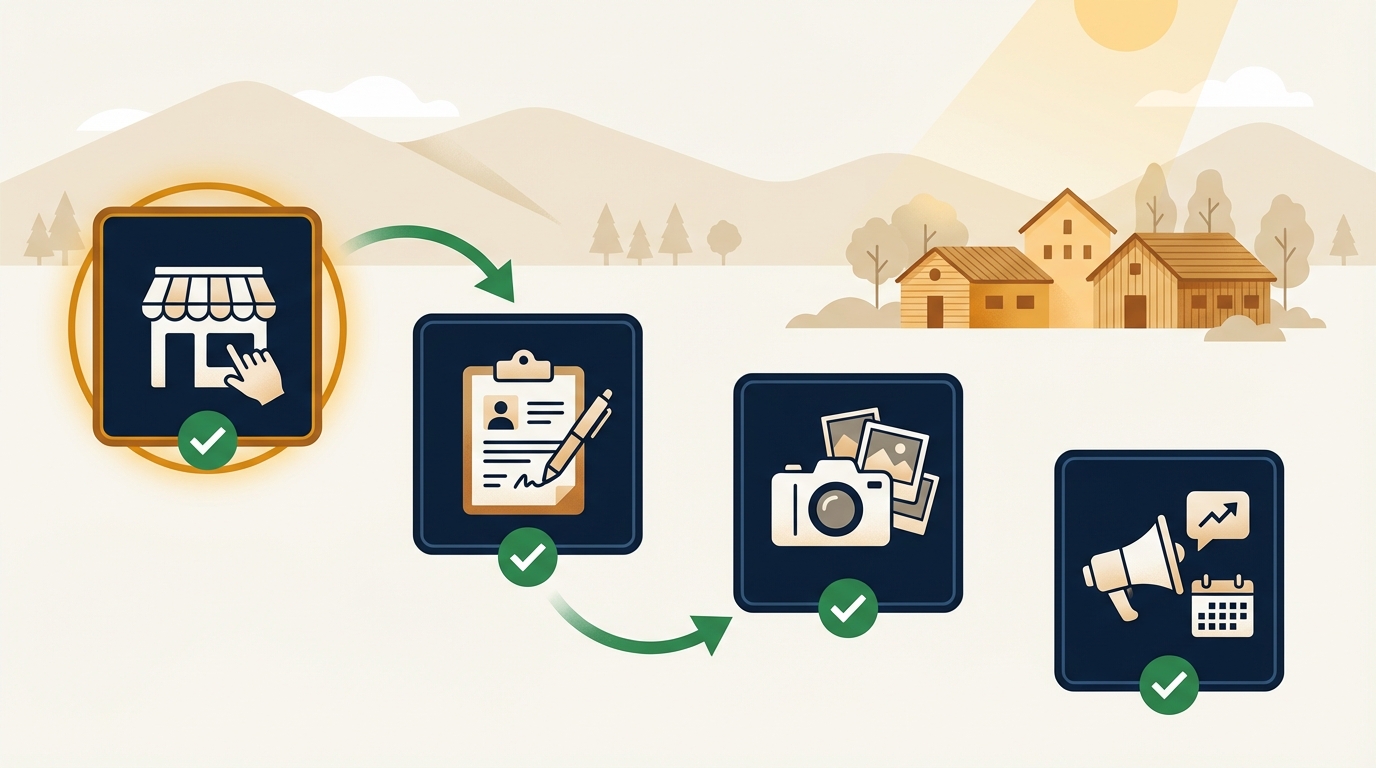
Here is what a complete profile looks like.
Claim and verify your listing
If you have not claimed your Google Business Profile, do it today. Go to business.google.com, search for your business, and follow the verification process. Google typically verifies via postcard, phone, or video — it takes a few days but it is straightforward.
If your listing already exists (Google creates them from public data), claim it so you control the information. Unclaimed listings often have wrong hours, outdated phone numbers, or a missing website link.
Fill in every field
Google rewards completeness. Profiles that are fully filled out are seven times more likely to get clicks than incomplete ones. Do not skip any field:
- Business name — Use your real business name. Do not stuff keywords (“Joe’s Plumbing - Best Plumber Charleston WV” will get flagged).
- Primary category — This is the single most influential ranking factor in the local pack. Choose the most specific category that describes your main service.
- Secondary categories — Add every category that genuinely applies to your business.
- Address — Exact match with your other listings. More on this below.
- Phone number — Use a local number, not a toll-free number.
- Website — Link to a location-specific landing page if you serve multiple areas.
- Hours — Keep these accurate, including holiday hours. Customers lose trust fast when they drive to a business that Google says is open but is not.
- Business description — Write 750 characters that explain what you do, who you serve, and what makes you different. Include your primary service area naturally.
- Services/Products — List every service or product you offer with descriptions.
- Attributes — Check every relevant attribute (women-owned, veteran-owned, wheelchair accessible, etc.).
Post regularly
Google Business Profile posts are short updates that appear on your listing. Businesses that post weekly see higher engagement and visibility. Share:
- Seasonal offers or promotions
- Before-and-after photos of completed work
- Quick tips related to your industry
- Community involvement (local events, sponsorships)
Add photos — lots of them
Businesses in the top three local pack positions typically have over 250 images on their profiles. You do not need that many to start, but aim for 25-50 quality photos. Include:
- Your storefront or office exterior (helps Google match your location)
- Interior shots
- Your team at work
- Completed projects or products
- Your service vehicles (with your branding visible)
Upload 5-10 new photos monthly. Real photos always outperform stock images.
NAP consistency: the foundation you cannot skip
NAP stands for Name, Address, Phone number — the three pieces of information that identify your business across the internet. When your NAP is inconsistent across different directories and listings, Google loses confidence in your legitimacy.
The data backs this up. Businesses with 95% or higher NAP consistency across their top 50 citations rank an average of 3.2 positions higher in local pack results. Businesses with consistent NAP data are 40% more likely to appear in the local pack at all.
What counts as inconsistent
Small differences matter. These are all different NAPs in Google’s eyes:
- “Joe’s HVAC” vs “Joe’s HVAC LLC” vs “Joes HVAC”
- “123 Main St” vs “123 Main Street” vs “123 Main St.”
- “(304) 555-1234” vs “304-555-1234” vs “3045551234”
Pick one exact format for each field and use it everywhere. No exceptions.
Where to check and fix
Start with the directories that matter most:
- Google Business Profile — Your anchor. Everything else should match this.
- Bing Places — Microsoft’s equivalent. Often auto-populated with errors.
- Apple Maps — Growing fast, with usage nearly doubling from 14% to 27% in the past year.
- Yelp — Still influential for local search signals.
- Facebook — Your business page address and phone must match.
- Industry-specific directories — Angi, HomeAdvisor, or Healthgrades depending on your industry.
- Local directories — Your local Chamber of Commerce, Better Business Bureau, and regional business directories.
- Data aggregators — Neustar Localeze, Data Axle, and Foursquare feed information to hundreds of smaller directories. Fixing these cascades corrections everywhere.
For a West Virginia business, also check your listing on the WV Secretary of State’s business registry and any regional tourism directories if you are in the hospitality industry.
Reviews: the ranking factor that keeps growing
Reviews have always mattered for local search. In 2026, they matter more than ever.
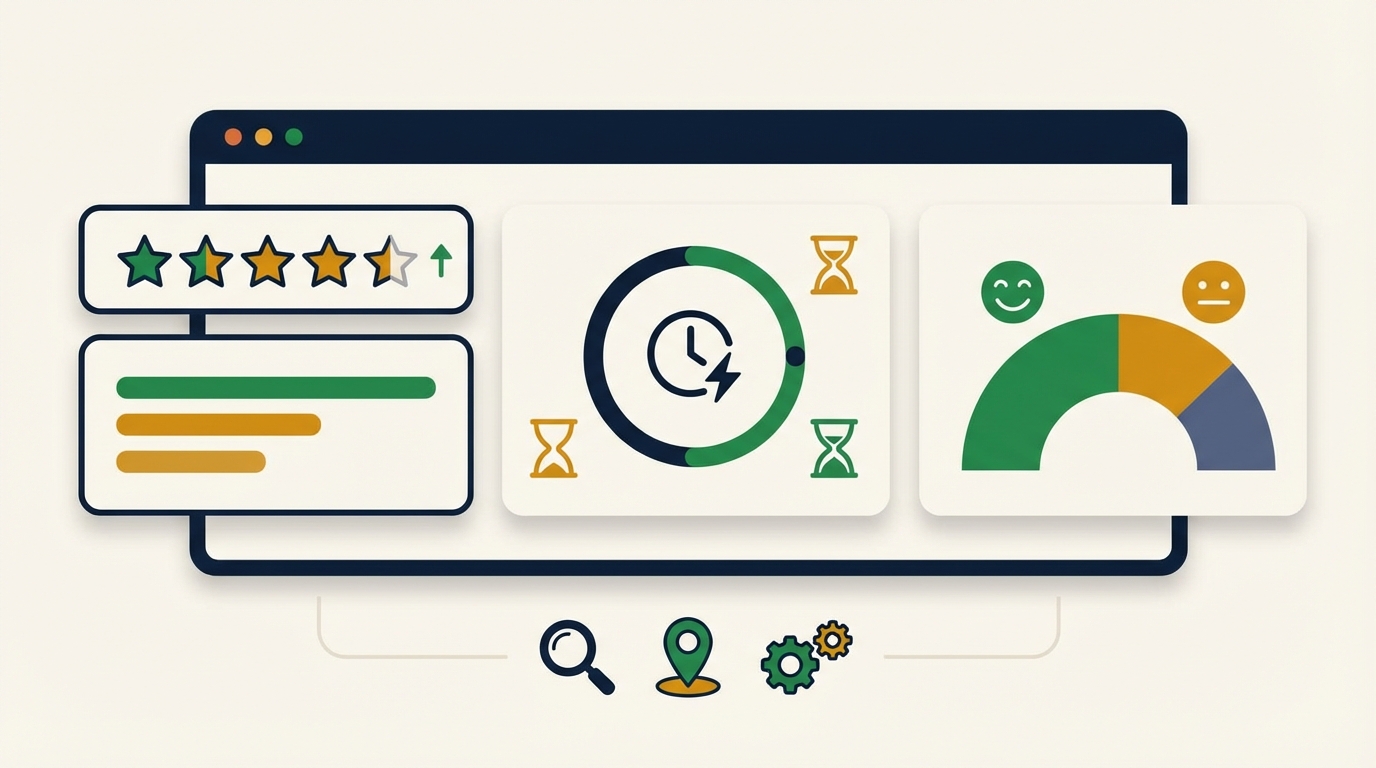
The 2026 Local Search Ranking Factors survey shows review signals grew from 16% to 20% of local pack ranking weight since 2023 — the largest increase of any factor category. And consumer expectations are rising even faster.
The numbers
BrightLocal’s 2026 survey found dramatic shifts in consumer behavior:
- 41% of consumers always read reviews when browsing for local businesses — up from 29% just one year ago.
- 31% will only use a business with 4.5 stars or more — nearly double last year’s 17%.
- 68% require at least 4 stars before they will even consider a business.
- 73% ignore reviews more than a month old. Recency matters as much as quantity.
Listings with 50+ reviews and a 4.5+ star rating are 57% more likely to rank in top local results. Businesses with 200+ reviews generate twice the revenue of those with fewer.
How to build a review pipeline
Asking for reviews should be a routine part of your business operations, not an afterthought.
- Ask at the point of satisfaction. The best time to ask is immediately after you have delivered value — a completed repair, a great meal, a successful project. The customer’s positive feeling is freshest.
- Make it easy. Send a direct link to your Google review page via text message. Google provides a short URL in your GBP dashboard. One tap, write a review, done.
- Follow up once. If someone agrees to leave a review but does not, one polite follow-up text the next day is fine. Do not nag.
- Never offer incentives. Google prohibits incentivized reviews and actively penalizes businesses caught doing it, especially after the August 2025 spam update.
Respond to every review
Nineteen percent of consumers now expect a response to their review on the same day. Another 32% want a response by the next day. And 89% expect responses to both positive and negative reviews.
This is where many small business owners fall behind. You are on a job site, not monitoring your Google reviews. But those unanswered reviews send a signal to both customers and Google that you are not engaged.
AI tools can help here. Five Star monitors your reviews across platforms and drafts personalized responses within minutes of a new review posting. You approve the response with a tap, and the customer sees a thoughtful reply while you are still on the job. It turns a two-hour-per-week chore into a 30-second daily check.
AI is changing local search — here is what to watch
Google’s AI Overviews are reshaping how search results look and how users interact with them. If you are investing in local SEO, you need to understand what is coming.
AI Overviews and local search
Across all search categories, AI Overviews have reduced click-through rates by 34-61%. That is significant. But local search has been comparatively insulated — only about 8% of local queries trigger an AI Overview so far.
The reason is practical: local searches require current, location-specific information that AI summaries struggle to provide reliably. Google knows that showing an AI-generated answer for “plumber near me open now” is risky if the information is wrong. So for now, local pack results remain prominent.
But that will change. Google expanded AI Overviews for restaurant queries by 387% and travel queries by 381% during 2025. Local businesses in hospitality and tourism should prepare now.
Consumers are asking AI for recommendations
Perhaps the most striking finding in BrightLocal’s 2026 survey is this: use of ChatGPT and other generative AI tools for local business recommendations has grown from 6% to 45% in a single year. It is now the third most popular way consumers find businesses, after Google and word of mouth.
When someone asks ChatGPT “Who is the best electrician in Charleston, WV?”, the answer is shaped by your online presence — your reviews, your website content, your directory listings. The businesses with the strongest, most consistent digital footprint get recommended.
What this means for your strategy
The good news is that the fundamentals of local SEO — an optimized Google Business Profile, consistent NAP, strong reviews, quality website content — also drive visibility in AI-powered search. The 2026 ranking factors survey found that citations rank third in importance for AI search visibility, even higher than their weight in traditional local pack rankings.
In other words, doing local SEO well today also positions you for the AI-powered search landscape of tomorrow.
Building local content that ranks
Your website is where local SEO and traditional SEO converge. A well-structured site with locally relevant content tells Google — and your customers — exactly where you are and what you do.
Location pages
If you serve multiple areas, create a dedicated page for each one. A plumbing company in Charleston that also serves Huntington, Beckley, and Parkersburg should have separate pages for each city — not one generic “service areas” page.
Each location page should include:
- Your business name and the city/region in the page title
- Unique content about the services you offer in that area
- Your address (or service area description) for that location
- Embedded Google Map
- Local schema markup (LocalBusiness JSON-LD)
- Reviews or testimonials from customers in that area
Blog content for local authority
Regular blog content that addresses local topics builds topical authority and creates internal linking opportunities. Write about:
- Seasonal issues in your area (winterizing pipes in mountain communities, spring HVAC tune-ups)
- Local regulations or permits relevant to your industry
- Community events you participate in
- Industry trends that affect local businesses
If you struggle to find time to create content consistently, tools like Content Forge let you turn a quick voice memo about a common customer question into a polished blog post. Fifteen minutes of talking becomes an SEO-friendly article that works for you around the clock.
Schema markup
Structured data helps Google understand your business information definitively. At minimum, implement LocalBusiness schema on your homepage and location pages:
{
  "@context": "https://schema.org",
  "@type": "LocalBusiness",
  "name": "Your Business Name",
  "address": {
    "@type": "PostalAddress",
    "streetAddress": "123 Main Street",
    "addressLocality": "Charleston",
    "addressRegion": "WV",
    "postalCode": "25301"
  },
  "telephone": "+1-304-555-1234",
  "url": "https://yourbusiness.com",
  "openingHoursSpecification": [...]
}
This markup does not guarantee higher rankings, but it helps Google parse your information accurately — especially important when your NAP consistency across directories is what you are building on.
Measuring what matters
Local SEO is a long-term strategy. Do not expect page-one rankings in a week. But you should track progress monthly so you know what is working.
Key metrics to watch
| Metric | Where to find it | What it tells you |
|---|---|---|
| Google Business Profile views | GBP Insights | How often your listing appears in search and maps |
| GBP actions (calls, directions, website clicks) | GBP Insights | How many searchers took action after finding you |
| Local pack position | Manual search or tracking tools | Where you rank for your target keywords |
| Review count and average rating | Google, Yelp, Facebook | Your reputation signal strength |
| Website traffic from organic search | Google Analytics / Search Console | How much search traffic reaches your site |
| Phone calls from search | Call tracking or GBP data | Direct revenue impact |
A realistic timeline
| Month | What to expect |
|---|---|
| Month 1 | GBP optimized, NAP audit complete, review request process in place |
| Month 2-3 | First ranking improvements for low-competition keywords |
| Month 4-6 | Consistent review growth, local pack appearances for more keywords |
| Month 6-12 | Strong local pack positions for primary keywords, measurable increase in calls and website traffic |
Local SEO compounds. Each review, each citation, each piece of content builds on the last. Businesses that stay consistent for six months to a year see results that are difficult for competitors to displace.
Start with what matters most
You do not need to do everything at once. Here is where to start, in order of impact:
- Claim and optimize your Google Business Profile. This is the highest-leverage action you can take. A complete, accurate profile with photos and regular posts puts you ahead of most local competitors immediately.
- Fix your NAP consistency. Audit your top ten directory listings and make them match exactly. This work is tedious but foundational.
- Build a review pipeline. Start asking every satisfied customer for a Google review. Respond to every review within 24 hours — or use AI-powered review management to handle responses automatically.
- Create location-specific content. One well-written page per service area on your website, with proper schema markup.
- Check your local SEO tools. Use Appalach.AI’s local SEO tools to audit your current presence and identify gaps.
Local SEO is not glamorous. It is not the kind of marketing that wins awards. But for West Virginia businesses competing in local markets, it is the most reliable way to put your business in front of customers who are ready to buy — today and as AI continues to reshape how people search.