
74% of SMBs now skip banks for working capital — what it signals
The bank is no longer the first call
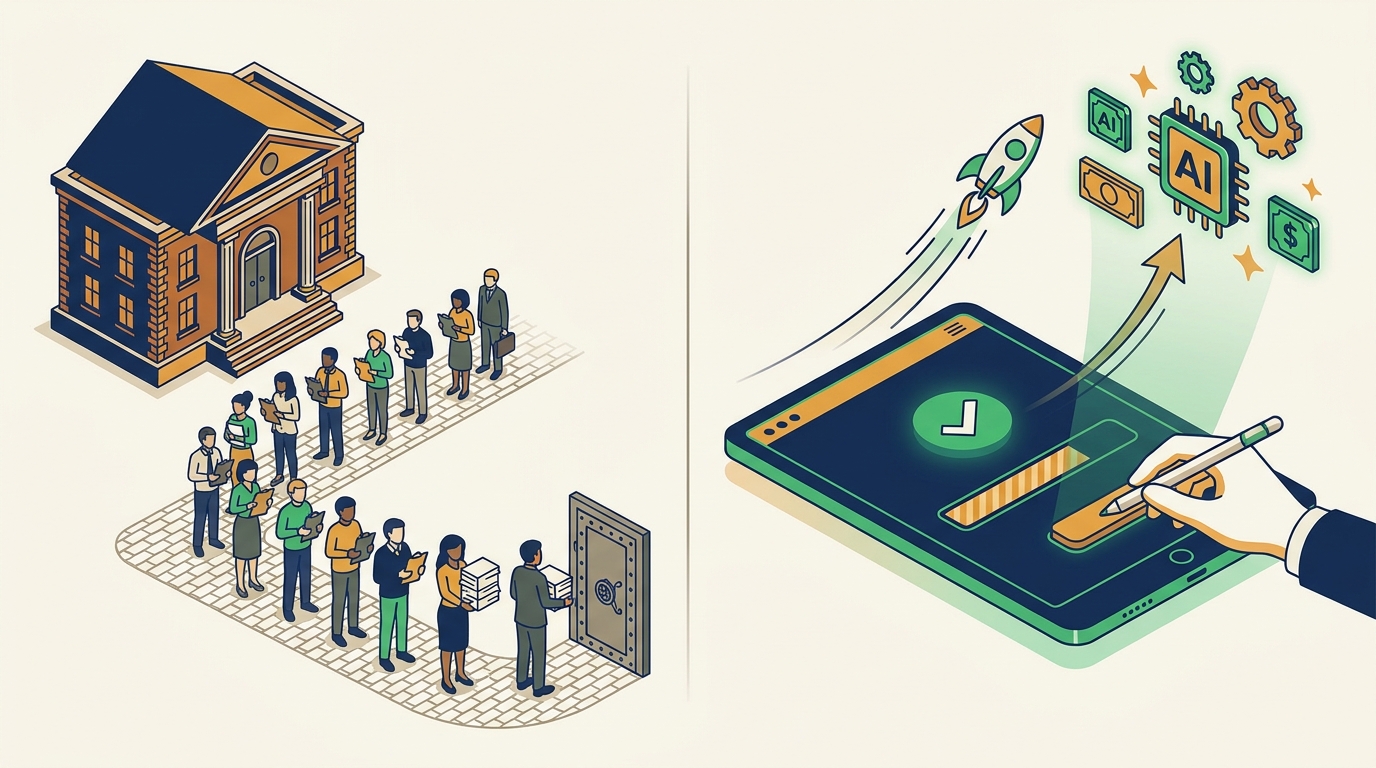
Three out of four small business owners now prefer a non-bank lender over a traditional bank when they need working capital. That number comes from the OnDeck and Ocrolus 2026 Small Business Cash Flow Trend Report, published in early 2026 and based on 468 small business surveys plus 3.45 million working capital applications. The shift is not subtle, and it has direct implications for how you fund the AI tools and automation you’re planning this year.
For Appalachian businesses watching cash flow tightly while inflation and consumer caution linger, where you borrow now matters as much as how much you borrow. Speed-to-capital is becoming a competitive variable in its own right.
What the report actually found
The headline numbers from the OnDeck and Ocrolus report tell a coherent story:
- 74% of small businesses prefer non-bank lenders for working capital.
- 94% of small business owners project growth in 2026 — matching an all-time survey high.
- 56% of small businesses report using AI, and 87% of those users report positive business impact.
- 31% name inflation as their top Q4 challenge; 29% name cash flow.
- 38% cite consumer spending trends as a key strategic planning factor; 37% name access to credit.
The data was collected between December 15 and 23, 2025, and covers a 15-month application window — so this is recent, broad, and reflects the conditions you’re actually planning around right now.
“Small business owners are entering 2026 with confidence and clarity. They’re investing in AI and maintaining disciplined cash flow strategies while using a wider range of financing options,” said Cory Kampfer, Co-President of Small Business at Enova (OnDeck’s parent company), in the report’s announcement.
Why speed beats rate in AI-driven growth
A traditional bank loan for a $50,000 line of credit can take three to six weeks to close, assuming your file is clean. Non-bank lenders that underwrite from cash flow data instead of tax returns and projections can close in 24 to 72 hours. That gap is the entire story.
When you’re paying for AI tools, the math has changed. A few examples of why timing matters more than it used to:
- AI tooling is monthly, not annual. Most useful SMB AI tools — review managers, dispatch systems, content generators, intake widgets — are subscription-priced. You don’t need a five-year capex loan; you need fast, flexible cash that matches the cadence of the spend.
- Quick wins compound. A roofing contractor who funds AI-powered scheduling in week one captures an extra month of summer bookings. A contractor who waits six weeks for bank approval misses that window entirely.
- Pilots beat plans. AI investments work best when you can test, measure, and iterate. Capital that arrives in 48 hours lets you run a 30-day pilot. Capital that arrives in 30 days forces you into bigger, riskier commitments.
The OnDeck/Ocrolus data backs this up. The 87% of AI-using SMBs who report positive business impact aren’t all running enterprise platforms — most are running small, focused experiments funded with flexible capital.
How small businesses fund AI tools and automation
The categories of AI spending that the OnDeck report flags as growing fastest line up almost exactly with what we see Appalachian SMBs investing in:
| Spend category | Typical monthly cost | Funding fit |
|---|---|---|
| AI marketing tools (SEO, content, ads) | $50–$500 | Card or operating cash |
| AI customer service / intake (like Hollr) | $100–$1,000 | Operating cash or short-term line |
| AI employees / specialized agents | $200–$2,000 | Short-term line of credit |
| Custom AI development | $5,000–$50,000 | Project-based working capital loan |
| Hardware + setup (POS, cameras, sensors) | $2,000–$25,000 | Equipment loan or term loan |
Most AI tools fall in the bottom three rows of that table — the spots where a fast non-bank lender genuinely outperforms a traditional bank. The bank is still the right answer for a building purchase or a five-year truck fleet. It’s increasingly the wrong answer for a six-month software pilot.
The 63% of AI-using small businesses who concentrate their AI investment in marketing — per the same OnDeck report — are particularly well-served by short-term, cash-flow-based capital. Marketing AI is measurable, reversible, and pays back fast. That risk profile matches non-bank underwriting better than it matches a 36-month bank term loan.
If you’re mapping a 12-month AI roadmap, the services overview walks through how we think about the financial side of that planning.
When a non-bank lender makes sense — and when it doesn’t
The shift to non-bank lenders is real, but it isn’t a blanket win. Here’s where the trade-offs land:
A non-bank lender is the right call when:
- You need capital in under a week.
- The use case has a measurable payback in under 12 months.
- You have strong recent revenue but a thin or imperfect credit file.
- You’re funding a pilot, not a permanent build-out.
- The total need is under $250,000.
A traditional bank or SBA loan is still the right call when:
- You’re buying real estate, a vehicle fleet, or major equipment.
- The total need is over $500,000 and amortizes over 5+ years.
- You qualify for an SBA 7(a) or 504 loan and rate matters more than speed. The SBA’s current loan programs are typically 200–600 basis points cheaper than non-bank alternatives.
- You already have a strong banking relationship and can close in three weeks or less.
The honest framing: speed has a price. Non-bank lenders charge for it. A typical non-bank line of credit will run 15–35% APR (sometimes presented as a flat factor rate, which obscures the true APR — always convert to APR before comparing). An SBA 7(a) loan in May 2026 is closer to 10–12%. If you can wait three weeks, the bank wins on cost. If you can’t, you’re paying the speed premium for a reason — quantify it.
Three things to do before your next financing decision
The capital landscape changed. Your decision process should change with it. Three concrete actions worth taking this quarter:
-
Pre-qualify with two non-bank lenders before you need money. Most run a soft pull, take 10 minutes, and give you a real offer. Knowing your number in advance means you can move fast when an opportunity (or an emergency) appears. OnDeck, Bluevine, and Funding Circle are three commonly cited names — there are dozens of others. Don’t apply hard until you’re ready to draw.
-
Track your “AI margin” separately. If you’re spending $800/month on AI tools and they’re saving 20 hours of staff time, write that down. The 87% of SMBs reporting positive impact are the ones who measured. If you can show a non-bank lender a clean ROI on AI spend, you’ll get better terms on the next round.
-
Match the loan term to the spend. A 6-month line of credit for a 6-month software pilot. A 5-year term loan for a 5-year truck. Don’t take a 24-month loan to fund a 3-month experiment — and don’t put a permanent equipment purchase on a revolving line. Term mismatch is the most common mistake we see in SMB financial planning.
What to watch over the next 12 months
A few signals worth tracking as the financing landscape continues to shift:
- Bank consolidation in rural markets. If your local bank gets acquired, your relationship resets. That’s a moment to lock in pre-qualifications elsewhere.
- AI underwriting at non-bank lenders. The same Ocrolus that produces the cash flow report is the company powering much of the AI underwriting at non-bank lenders. Decisioning is getting faster and more nuanced — meaning a “no” today might be a “yes” in six months without you doing anything.
- SBA program changes. SBA loan limits and program eligibility shift with each fiscal year. The SBA’s news page is worth a quarterly check.
The structural takeaway from the OnDeck/Ocrolus data is straightforward: small business financing is bifurcating. Banks own the long, large, secured deals. Non-bank lenders own the fast, flexible, cash-flow-based deals. AI investment lives almost entirely in the second category — and the 74% number says small business owners have already figured that out.
If you’re sketching an AI roadmap and aren’t sure how to fund it without straining cash flow, get in touch. We help Appalachian small businesses sequence AI investments to match the capital they actually have access to — not the capital a vendor wishes they had.