
AI Lead Capture for Plumbers: Never Miss an Emergency Call
The plumbing lead problem
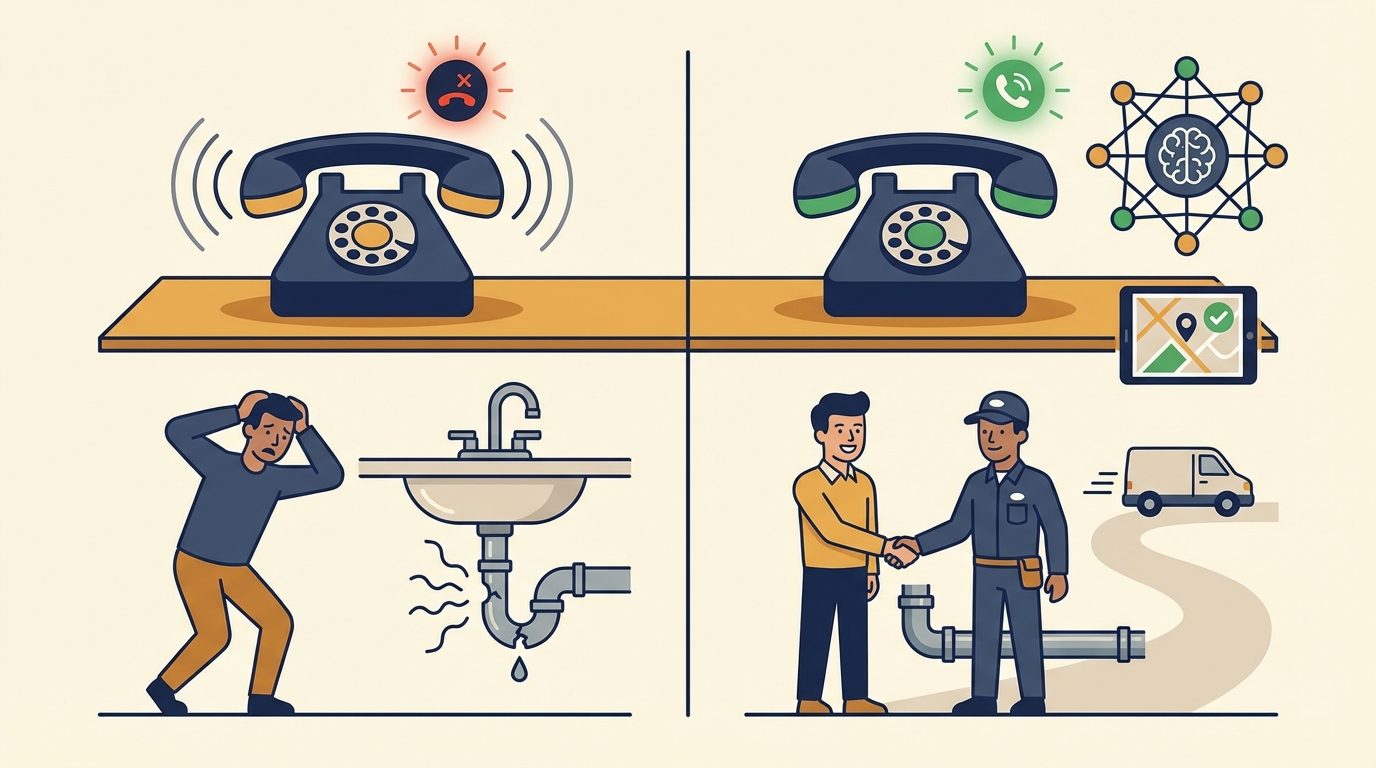
A pipe bursts at 11 PM on a Friday. The homeowner grabs their phone, searches “emergency plumber near me,” and starts calling. The first shop? Voicemail. The second? Same thing. The third plumber picks up — or at least, something does — and books the job before the homeowner even considers calling back those first two numbers.
This scenario plays out thousands of times every week across the country. According to Invoca’s call analytics data, home services businesses miss roughly 27% of inbound calls. For plumbing companies, where emergencies drive a significant chunk of revenue, that number translates directly to lost jobs and lost income.
The math is brutal. The average plumbing service call generates $200 to $800 in revenue, with emergency calls commanding 1.5 to 3 times standard rates. Miss just a few of those calls per week, and you are looking at $50,000 or more in annual lost revenue — money that went straight to the competitor who answered first.
AI lead capture solves this problem without requiring you to hire a night-shift receptionist or chain yourself to your phone. It answers every call, qualifies the lead, triages emergencies, and books appointments — around the clock.
Why speed wins in plumbing
Plumbing is not like hiring a painter or scheduling a kitchen remodel. When someone calls a plumber, the situation is usually urgent. A clogged drain, a leaking water heater, a frozen pipe about to burst. They are not comparison shopping — they are calling until someone picks up.
Research from MIT and InsideSales.com found that businesses responding to leads within five minutes are 21 times more likely to qualify that lead compared to waiting 30 minutes. A separate Harvard Business Review study of 2.24 million sales leads confirmed: companies reaching out within the first hour were nearly seven times more likely to convert versus those who waited longer.
In plumbing, “speed to lead” is not just a marketing concept. It is the entire business model. 78% of buyers go with the first company that responds, according to lead response research. When a homeowner has water pooling on their basement floor, they are not leaving a voicemail and waiting patiently for a callback.
The after-hours problem
Emergency plumbing calls do not follow a 9-to-5 schedule. Industry data suggests that a significant portion of urgent calls come in after business hours — evenings, weekends, and holidays. These are often the highest-value calls, too. Emergency jobs average $450 to $600 in immediate revenue thanks to after-hours surcharges and the urgency of the work.
Most small plumbing shops handle this one of three ways:
- Ignore after-hours calls — they go to voicemail, and 85% of callers hang up without leaving a message
- Forward to the owner’s cell phone — which means you are never really off the clock
- Hire a live answering service — which costs $200 to $500 per month and still can not book appointments or triage emergencies intelligently
None of these options are great. The first loses money. The second leads to burnout. The third adds cost without adding much capability.
How AI lead capture works for plumbing businesses
AI lead capture replaces the voicemail black hole with an intelligent system that handles calls and website inquiries the way a well-trained office manager would — except it never sleeps, never calls in sick, and never puts a caller on hold.
Here is how the process works:
Step 1: The customer reaches out
Whether it is a phone call, a text message, or a chat on your website, the AI answers immediately. No hold music. No “press 1 for scheduling, press 2 for billing.” Just a natural conversation.
An AI intake widget on your website can greet visitors and start gathering information the moment they land on your page. On the phone side, voice AI handles the call like a real person.
Step 2: AI qualifies and triages the lead
This is where AI outperforms a basic answering service. Instead of just taking a message, the AI asks the right questions:
- What is the problem? (Leaking pipe, clogged drain, water heater, sewer line)
- How urgent is it? (Active flooding vs. slow drip vs. routine maintenance)
- Where are they located? (Within your service area?)
- When do they need service? (Right now vs. this week vs. flexible)
Based on the answers, the system categorizes the lead as emergency, urgent, or routine — and routes it accordingly.
Step 3: Booking and routing
For emergency calls, the AI can immediately alert your on-call technician via text or push notification with the customer’s information, location, and problem description. For routine calls, it books the appointment directly into your scheduling system based on available time slots.
This is the workflow that tools like Dispatch AI handle automatically. The customer gets a confirmation. Your team gets a clean, organized job ticket. Nobody falls through the cracks.
Step 4: Follow-up
After the initial contact, AI handles the pieces that usually slip through the cracks in a busy plumbing operation:
- Appointment reminders sent by text to reduce no-shows
- Estimate follow-ups for customers who got a quote but have not booked yet
- Review requests sent after the job is complete
- Seasonal reminders for maintenance services (winterization, water heater flushes)
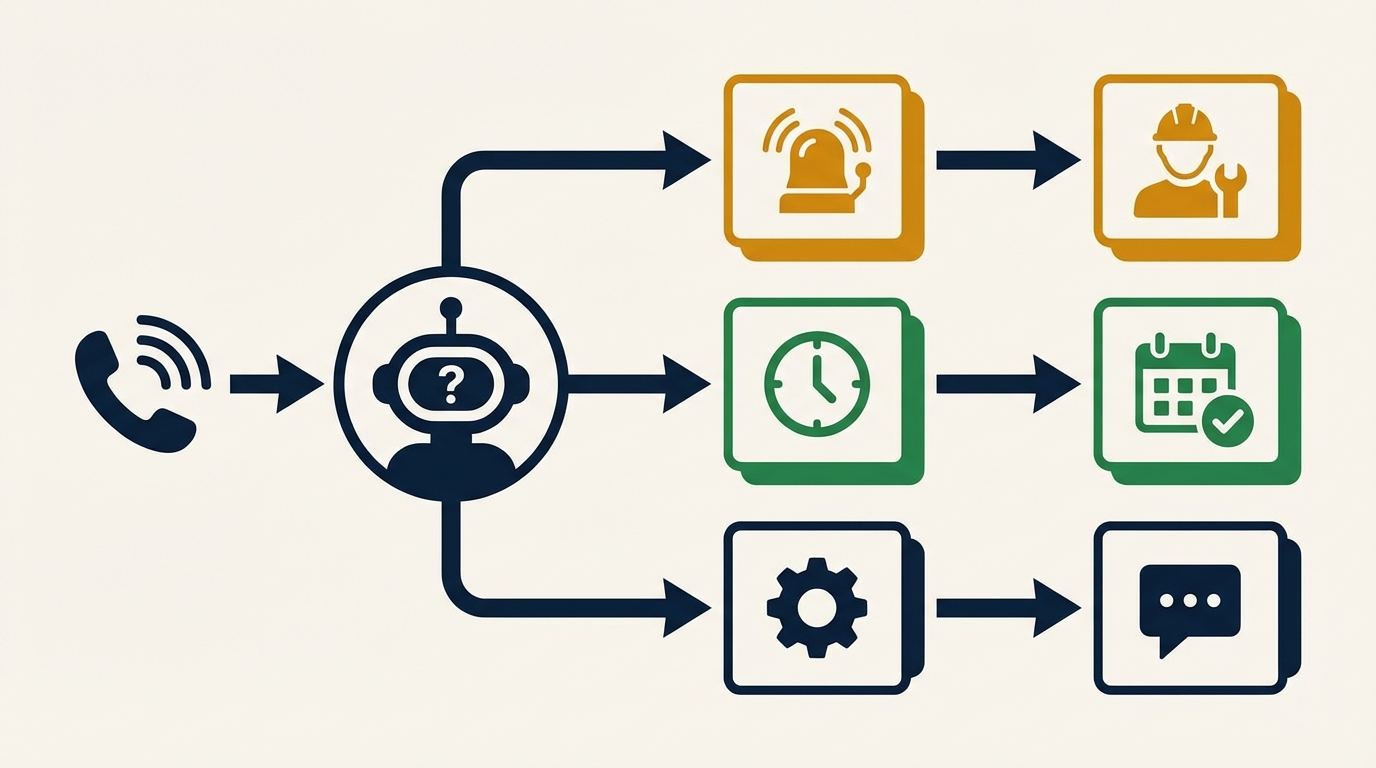
Emergency triage: how AI prioritizes urgent vs. routine calls
Not every plumbing call is an emergency, and not every emergency requires the same response. AI triage systems use the information gathered during intake to sort calls into priority levels:
| Priority | Situation | AI response |
|---|---|---|
| Critical | Active flooding, sewage backup, gas line concern | Immediate alert to on-call tech + customer gets ETA |
| Urgent | No hot water, significant leak (contained), frozen pipes | Books next available slot + alerts dispatch |
| Standard | Slow drain, running toilet, faucet replacement | Books regular appointment within the week |
| Low | Quote request, maintenance scheduling, general inquiry | Schedules callback during business hours |
The key advantage over a live answering service is consistency. A human operator at 3 AM might not ask the right follow-up questions to distinguish between a contained leak and active flooding. AI follows the same triage protocol every single time.
This matters for your business beyond just customer service. When your technician gets dispatched to an emergency at midnight, they arrive with the right information — what kind of problem, how long it has been going on, whether water is shut off — instead of a vague “customer says there’s a leak.”
Cost comparison: AI vs. answering service vs. missing calls
Here is where the numbers tell the story. Let’s compare three scenarios for a typical small plumbing business handling 40 calls per week:
| Factor | Missing calls | Live answering service | AI lead capture |
|---|---|---|---|
| Monthly cost | $0 | $250–$500 | $50–$200 |
| After-hours coverage | None | Limited (message only) | Full (triage + booking) |
| Call answer rate | ~73% | ~95% | ~99% |
| Can book appointments | No | Rarely | Yes |
| Can triage emergencies | No | Basic | Advanced |
| Estimate follow-up | Manual | No | Automated |
| Estimated monthly revenue lost | $4,000–$8,000+ | $500–$1,500 | $0–$500 |
The economics are straightforward. Plumbing leads from platforms like Angi cost $15 to $120 per lead, with exclusive leads running $75 to $200 or more. And those are shared leads — the same homeowner gets matched with three to five contractors simultaneously, so your conversion rate drops.
Compare that to the leads already calling your business directly. These are people who found your number, decided to call you, and are ready to hire someone. They are the highest-quality leads you will ever get, and they cost you nothing in acquisition fees. Letting them go to voicemail is like paying for a billboard and then locking your front door.
If you have read our guide on why every small business needs an AI answering service, the principle is the same — but the stakes are even higher in plumbing because of emergency-driven demand and the premium pricing that comes with it.
Setting up AI lead capture for your plumbing business
Getting started does not require a technology overhaul. Most plumbing businesses can have AI lead capture running within a day. Here is the practical path:
1. Start with your website
Add an AI intake widget to your website. This handles the visitors who find you through Google but prefer texting or chatting over calling. The widget qualifies leads in real time and feeds them directly into your pipeline.
2. Set up voice AI for phone calls
Configure your phone system to route unanswered calls — or all after-hours calls — to an AI system. The AI handles the conversation, gathers details, and either books the appointment or escalates to your on-call tech.
3. Define your triage rules
Tell the system how to categorize calls. What counts as a critical emergency? What qualifies as urgent? What can wait until Monday? These rules mirror the decisions you already make in your head every time a call comes in — the AI just applies them consistently, 24/7.
4. Connect your scheduling
Link the AI to your calendar or dispatch system. When it books an appointment, the job shows up in your schedule automatically. No double-booking, no manual entry, no sticky notes that get lost.
5. Test with real scenarios
Before going live, run through common call scenarios. A burst pipe at midnight. A slow drain on a Tuesday afternoon. A price inquiry from someone who is not ready to book yet. Make sure the AI handles each one the way you would want your best office manager to handle it.
What to expect in the first 30 days
The first month with AI lead capture typically follows a predictable pattern:
Week 1: You will notice calls that previously went to voicemail are now getting answered and logged. The most immediate impact is after-hours — suddenly you have a record of every call that came in overnight, with details about what the customer needs.
Week 2: Your booking rate starts climbing. Customers who would have called the next plumber in the search results are now booking with you because they got an immediate response. Expect a 15 to 25% increase in booked jobs.
Week 3: The follow-up automation kicks in. Customers who got estimates but did not commit are getting gentle follow-ups. Review requests are going out after completed jobs. Your Google review count starts ticking up.
Week 4: You have enough data to see the full picture. Compare your booked jobs, revenue, and response metrics to the previous month. Plumbing businesses similar in size to those in Appalachian markets — where competition for skilled trades is fierce and word-of-mouth matters — typically see the biggest impact because every captured lead has an outsized effect in a close-knit community.
The plumber’s AI advantage
The plumbing industry is a $166.5 billion market with over 128,000 businesses competing for work. The Bureau of Labor Statistics projects steady demand with 44,000 openings annually through 2034. The work is not going away — but the businesses that capture it most efficiently will pull ahead.
AI lead capture is not about replacing the personal touch that makes a local plumbing business successful. It is about making sure that personal touch actually has the chance to happen. Right now, every call that goes to voicemail is a customer who never gets to experience your service quality, your reliability, or your expertise.
The plumbing businesses gaining an edge right now are not necessarily the ones with the biggest trucks or the most technicians. They are the ones that answer every call. If you are ready to stop losing emergency calls to voicemail, explore how Dispatch AI handles lead capture and scheduling for service businesses, or see how an AI intake widget can work on your website.