
AI Lead Nurturing for Real Estate: Convert More Listings
The real estate lead problem
You just listed a property. Within hours, five inquiries come through Zillow, three from Realtor.com, two from your website, and a couple of text messages from an open house sign. By the time you finish showing a home across town, half of those leads have already contacted another agent.
This is the daily reality for real estate agents. The National Association of Realtors 2025 Technology Survey found that 41% of agents now use some form of AI, with 66% saying their primary motivation is saving time. The reason is obvious: the volume of leads has outpaced any single agent’s ability to respond manually.
The math is brutal. Research from InsideSales.com and MIT shows that agents who respond within five minutes are 21 times more likely to qualify a lead than those who wait 30 minutes. Yet the average agent takes over 15 hours to respond to a new inquiry. In a business where 78% of buyers work with the first agent who responds, that gap is costing you deals every week.
How AI lead nurturing works for real estate
AI lead nurturing uses machine learning and natural language processing to handle the initial stages of lead engagement automatically. Instead of a form submission sitting in your inbox until you check it, the system responds immediately, asks qualifying questions, and routes serious prospects to you — all while you focus on closings and showings.
Here is the basic flow:
- Lead arrives from any source — your website, Zillow, Realtor.com, social media, or a text inquiry
- AI responds instantly via text, email, or chat with a personalized message based on the lead source and property of interest
- Qualifying questions are asked naturally: timeline to buy or sell, pre-approval status, budget range, preferred neighborhoods
- Lead is scored based on responses, engagement level, and behavioral signals
- Hot leads get routed to you immediately with a summary of what the AI learned
- Warm leads enter nurture sequences with automated, personalized follow-ups over days, weeks, or months
The critical difference between AI nurturing and a basic autoresponder is intelligence. An autoresponder sends the same canned email to everyone. AI adapts its messaging based on what the lead says, how they behave, and where they are in the buying or selling process.
Automated follow-up sequences that feel personal
The biggest gap in most agents’ pipelines is not generating leads — it is following up consistently. Data from The Close shows that most online real estate leads convert between the 2nd and 12th contact attempt, but 80% of agents stop after the 3rd. That means four out of five agents give up right before the lead was about to convert.
AI solves this by never getting tired, distracted, or discouraged. Here is what effective AI follow-up looks like in practice:
Day one: immediate response
The AI texts or emails within seconds of the inquiry. The message references the specific property or search criteria the lead expressed interest in: “Hi Sarah, I saw you were looking at the 3-bedroom on Oak Street in Morgantown. Are you currently working with an agent, or would you like to schedule a showing?”
Days two through seven: value-driven touchpoints
If the lead does not respond immediately, the AI sends a series of helpful messages spaced over the next week. These are not generic “just checking in” emails. They include relevant market data, similar listings, neighborhood information, or mortgage rate updates tailored to what the lead was searching for.
Weeks two through twelve: long-term nurture
For leads that go quiet, the AI shifts to a monthly cadence. It monitors for re-engagement signals — if a cold lead suddenly visits your website again after two months, the AI automatically restarts a warmer sequence. Some systems follow up with unresponsive leads up to 25 times over 12 months, catching prospects who were not ready initially but become serious later.
The personal touch
Modern AI writes messages that sound like you, not a robot. The system learns your communication style and mirrors it. Leads often cannot tell they are interacting with AI until you personally step in for the showing or listing appointment.
AI qualification: sorting serious buyers from browsers
Not every lead is worth the same amount of your time. A first-time buyer with pre-approval who wants to close in 30 days is fundamentally different from someone casually browsing listings on a Sunday afternoon. AI qualification separates the two so you spend your hours where they matter most.
How AI scores leads
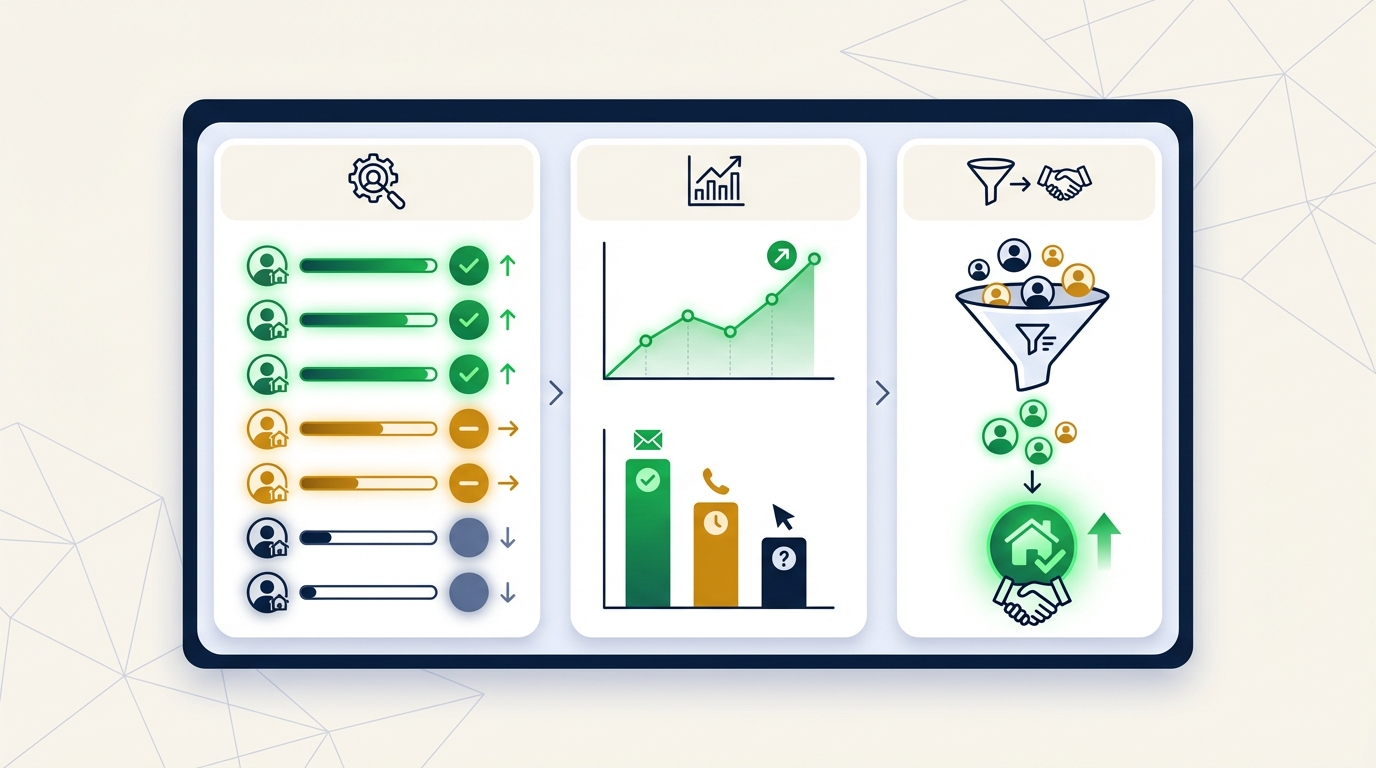
AI lead scoring analyzes multiple signals to rank prospects:
- Stated intent: Are they looking to buy, sell, rent, or just browse? When is their timeline?
- Engagement behavior: How many listings have they viewed? How long do they spend on property pages? Do they open your emails?
- Financial readiness: Are they pre-approved? Have they mentioned a budget? Are they asking about mortgage options?
- Response patterns: Do they reply quickly? Do they ask detailed questions about specific properties?
Each signal gets weighted, and the lead receives a score. High-scoring leads trigger an immediate alert to you. Medium-scoring leads stay in the AI nurture sequence. Low-scoring leads get a lighter-touch drip campaign.
The ROI of better qualification
Based on NAR data on average commission rates, each poorly handled lead on a median-priced home represents roughly $7,500 or more in potential commission income. If AI qualification helps you convert even two or three additional leads per quarter that you would have otherwise lost to slow follow-up, the tool pays for itself many times over.
The U.S. Chamber of Commerce reports that 60% of business operations now use AI — double the rate from 2023. Real estate is catching up fast. Agents who adopt AI lead qualification now are positioning themselves ahead of the curve in a market where speed and personalization are the primary differentiators.
Integrating AI with your MLS and CRM
AI lead nurturing is only useful if it fits into your existing workflow. The good news is that most modern AI tools are built to plug into the systems agents already use.
CRM integration
Your CRM is the hub. AI lead nurturing tools sync with platforms like Follow Up Boss, kvCORE, LionDesk, Wise Agent, and others. When the AI qualifies a lead, the contact record, conversation history, and qualification notes all flow directly into your CRM. You never have to copy and paste or manually enter data.
This integration works both ways. If you update a lead’s status in your CRM — say you met them at a showing and they are now an active buyer — the AI adjusts its nurture approach accordingly.
MLS and listing feeds
AI tools pull data from your MLS to personalize outreach. When a new listing matches a lead’s saved search criteria, the AI can send an alert with property details before you even see the listing yourself. When a price drops on a property a lead previously viewed, the AI sends a notification. This kind of automated market intelligence keeps your leads engaged without requiring you to manually monitor every listing change.
Website and landing page integration
For agents running their own websites, AI intake tools like Hollr replace static contact forms with conversational interfaces. Instead of a lead filling out a name-and-email form and waiting for a callback, they interact with an AI that asks the right questions, captures detailed information, and either books a showing or routes the lead to you immediately.
This approach eliminates the 81% form abandonment rate that plagues traditional web forms. A conversation feels natural. A form feels like homework.
Social media and advertising
AI nurturing extends to your paid advertising pipeline. Leads from Facebook ads, Google ads, or Instagram campaigns can be captured and immediately engaged by the AI. Since paid leads tend to be higher volume and lower initial quality, AI qualification is especially valuable here — it separates the serious prospects from the ad clickers so you do not waste time on leads that were never going to convert.
What agents in Appalachia should know
Real estate markets in Appalachian communities work differently than major metros. Inventory moves slower, relationships matter more, and word-of-mouth drives a significant share of business. AI lead nurturing is not about replacing that personal touch — it is about making sure no opportunity slips through the cracks while you are focused on the relationships that matter.
In rural and small-town markets, an agent often covers a wide geographic area. You might be 45 minutes from the office when a hot lead comes in. AI handles that initial response instantly, keeping the prospect engaged until you can connect personally.
Review management matters too. In tight-knit communities, your online reputation carries weight. Tools like Five Star AI help agents respond to every review promptly and professionally, building the kind of trust that turns one transaction into a referral network.
For agents who want to explore how AI can fit into their specific practice — whether you are a solo agent or a small brokerage — Appalach.AI’s small business solutions can help you evaluate the right tools for your market and budget.
Getting started with AI lead nurturing
You do not need to overhaul your entire business to start. Here is a practical path:
-
Audit your current response time. Check how long it takes you to respond to the last 10 leads that came in. If the answer is more than 15 minutes, AI can help immediately.
-
Start with one lead source. If most of your leads come from Zillow, set up AI nurturing for that channel first. Expand once you see results.
-
Choose a tool that integrates with your CRM. Do not adopt a standalone system that creates another silo. The AI should push data into whatever CRM you already use.
-
Set qualification criteria. Define what makes a lead “hot” for your market. Timeline, budget, pre-approval status, and geographic area are good starting points.
-
Review and refine weekly. Check the AI’s conversations. Are leads responding positively? Are qualified leads actually converting when you follow up? Adjust the messaging and scoring as you learn.
The agents who are winning in 2026 are not the ones with the biggest ad budgets. They are the ones who respond fastest, follow up most consistently, and never let a warm lead go cold. AI makes that possible without burning out or hiring a full-time assistant.
If you are ready to stop losing leads to voicemail and slow follow-ups, get in touch to see how AI lead nurturing can work for your real estate practice.