
UNO OS Launches AI Business OS: SMB Take on a Crowded Field
Another “AI operating system” hits the market
A new AI platform aimed at small and mid-sized businesses launched on April 27, 2026. UNO OS calls itself an “AI-driven operating system” for marketing, sales, executive operations, and client lifecycle management. The pitch sounds familiar because you have heard variations of it for two years.
The interesting question is not whether UNO OS will succeed. It is whether the “AI operating system” category — now occupied by dozens of vendors — actually solves the problem small businesses have, or just repackages it. For most Appalachian small businesses we work with, the honest answer is: not yet, and probably not in the form being sold.
What UNO OS actually shipped
UNO OS officially began operations on April 16, 2026 and announced its launch on April 27, according to the company’s press release on GlobeNewswire. The company is headquartered in Las Vegas and led by founder Siloh Moses, who has a notable personal story — seven months experiencing homelessness in Las Vegas before building an outreach initiative that the company says served more than 175,000 people.
The product itself is described in broad strokes. UNO OS covers four functional areas: marketing, sales, executive operations, and client onboarding and offboarding. The framework is presented as three steps — increase operational lift, strengthen profit margins, reduce operational drag.
A few details matter for any small business owner reading this:
- Target customer: U.S.-based businesses generating $6 million or more in annual revenue.
- Revenue goal: $1 million in revenue within nine months of launch.
- Pricing: Not disclosed in the launch materials.
- Specific features: Not detailed publicly. The press release describes outcomes, not modules.
That $6 million revenue floor is the most important fact in the announcement. If your business does $300,000 a year — typical for a single-location restaurant, contractor, or retail shop in Appalachia — you are not the target. The “small business” framing in coverage of the launch is generous. UNO OS is targeting the upper-mid-market, not a Main Street shop in Beckley or Wheeling.
The crowded “AI for business” landscape
UNO OS arrives in a category that is already loud. By rough count, there are now dozens of platforms positioning themselves as the AI-powered operating layer for a business. They split roughly into three buckets:
Enterprise AI platforms — Glean, Hebbia, Sana AI, Lindy, and similar tools that connect across enterprise systems and offer search, agents, and workflow automation. V7 Labs notes that Hebbia deployments typically price in the mid-to-high six figures annually, with Glean often positioned as a unified-search alternative. These are not SMB tools.
SMB suites with AI added — QuickBooks (with its new Workforce module), HubSpot, Microsoft 365 Copilot, Zoho. AI grafted onto existing software you may already use.
New “AI-first” platforms — UNO OS, plus a long tail of startups promising bundled AI for sales, marketing, and operations. Most have similar marketing copy. Few publish pricing.
The category problem is that these platforms are easy to describe and hard to evaluate. “AI for marketing, sales, and operations” is not a feature list. It is a category. A real evaluation requires knowing which models, which integrations, which workflows, what data goes where, and what happens if the vendor changes pricing or sunsets the product.
The U.S. Chamber of Commerce reports that the average small business now uses about five AI tools, with 82% of small business employers having invested in AI. The trend is real. The question is whether bundling those five tools into one platform helps or just creates a different kind of lock-in.
Build, buy, or assemble — the actual choice
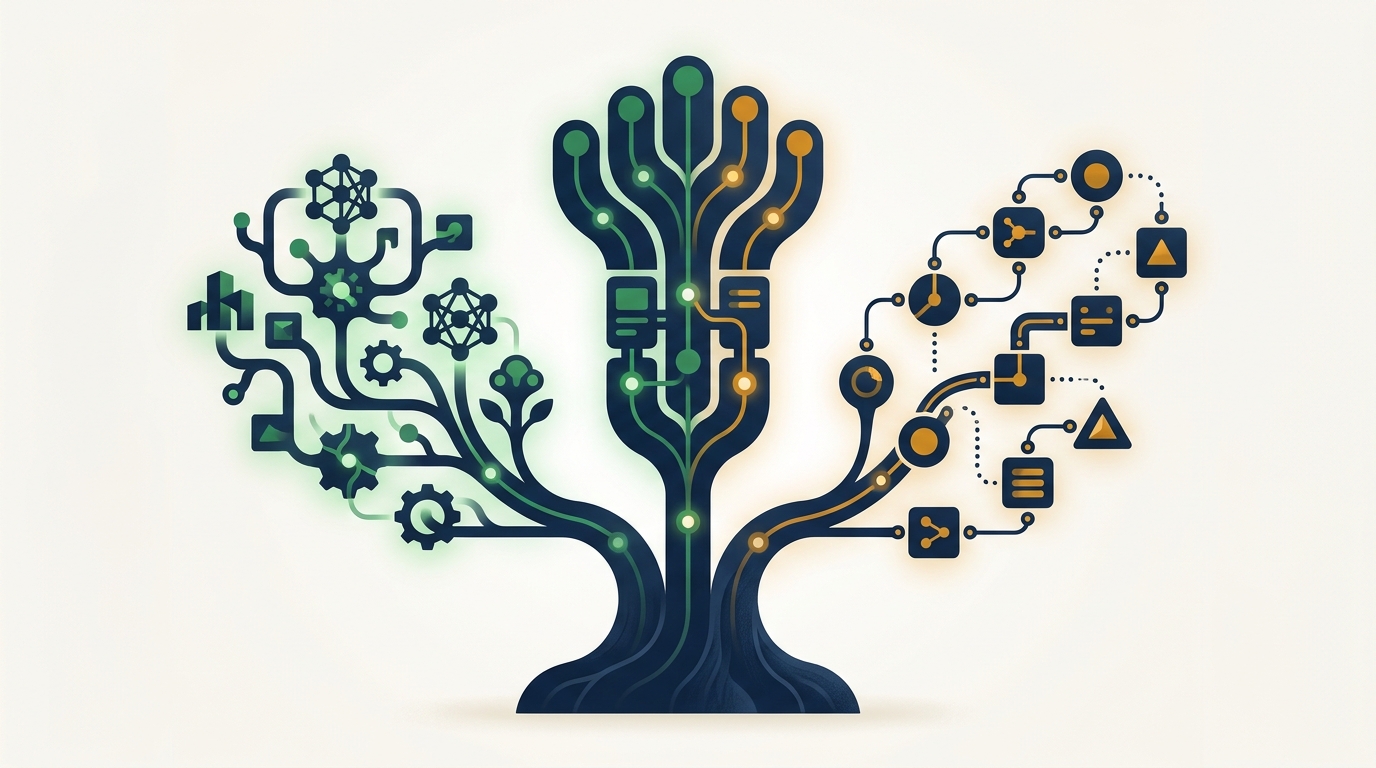
For most small businesses, the AI question is not “which platform should I commit to?” It is “which problem should I solve first?” That framing changes the answer.
There are three honest paths:
Build (custom): Hire a developer or agency to build something specific to your business. Best when you have unusual workflows or want to own the result. Higher upfront cost, lower ongoing cost. Most appropriate for businesses with at least one process that is genuinely differentiating.
Buy (platform): Sign up for a bundled tool like UNO OS, HubSpot, or QuickBooks AI. Best when your needs map cleanly to what the platform offers and you want predictable monthly costs. The risk is paying for modules you do not use and being unable to leave without rebuilding everything.
Assemble (point tools): Combine specific tools that solve specific problems. An AI answering service for missed calls. A scheduling agent like Dispatch for HVAC and plumbing dispatch. A review-management tool like Five Star. Each tool does one thing well. Cheaper to start, easier to swap, but requires someone to manage the integration.
For a $300K-revenue restaurant in West Virginia, the assemble path almost always wins. You do not need a $50,000-a-year AI operating system to handle your reservations, your reviews, and your inventory. You need three tools that work and a person who answers when something breaks. Our small business solutions page is built around that reality.
For a $6M-revenue regional contractor with five locations, the calculus shifts. Centralized data, consistent processes, and shared AI infrastructure start to matter more than tool-by-tool optimization. That is the bracket UNO OS is targeting, and the bracket where bundled platforms can earn their cost.
Questions to ask before you sign anything
If you are evaluating UNO OS — or any AI business platform — these are the questions that separate genuine value from a marketing deck:
- What models does it use, and can I see specifics? “Powered by AI” is not an answer. GPT-5.5, Claude Opus, DeepSeek V4, Llama — each has different costs, capabilities, and risk profiles.
- What is the pricing, in writing? A platform that will not publish pricing is asking you to negotiate from a weaker position. Walk away or get the number before the demo ends.
- Who owns the data? Specifically: where is it stored, who has access, and what happens if you cancel? GDPR.eu has solid background on data ownership questions even for U.S. businesses.
- What is the integration story? Does it actually connect to your existing tools — your CRM, your accounting, your scheduling — or does it expect you to migrate?
- What is the implementation cost beyond the subscription? Onboarding, training, customization, and the time your team spends learning the system. The subscription is rarely the largest cost.
- What is the exit cost? If you sign a one-year contract and decide it is not working, can you actually leave? Can you export your data in a usable format?
If a vendor cannot give you specific answers to those six questions in a 30-minute call, you have your answer about whether they are ready for your business.
What this signals about the SMB AI market
UNO OS itself is a single launch. The pattern it represents matters more.
The number of “AI operating system” startups now chasing the SMB market suggests that investors believe there is a winner-take-most opportunity here. There probably is — but the winner is unlikely to be the platform that markets itself most aggressively. It will be the one that solves a specific problem so well that everything else gets pulled along behind it.
For small businesses watching this space, the practical move is to ignore the platform pitches and start with the problem. Pick the single most expensive operational drag in your business — missed calls, slow invoicing, no-show appointments, abandoned reviews. Solve that with a focused tool. Then solve the next one. By the time you have three or four working pieces, you will know whether you actually need a unified platform or whether the assembled stack is doing the job.
If you want a sounding board on which problem to tackle first, that is the kind of thing our consulting service exists for. No platform commitment, no nine-month revenue goal — just a clear-eyed look at what is actually slowing your business down and what AI can realistically fix this quarter.