
AI for Retail: Smarter Inventory, Better Service
The playing field is shifting
A customer walks into your shop on a Saturday morning looking for a specific item. You’re pretty sure you have it in the back — but after ten minutes of searching, you realize you sold the last one on Wednesday and forgot to reorder. The customer leaves, pulls out their phone, and has it delivered from Amazon by Monday.
This scene plays out thousands of times a day in small retail stores across Appalachia and the rest of the country. Independent retailers account for over 98% of all retail businesses in the United States, yet they struggle against chains and e-commerce giants that spend billions on technology. The gap isn’t in product quality or customer relationships — it’s in the systems running behind the counter.
AI is closing that gap. Not the science-fiction version of AI that replaces human workers, but practical tools that handle the tedious, error-prone tasks that eat into your margins. From predicting which products will sell next week to answering customer questions at midnight, AI for retail is now affordable and accessible enough for a single-location shop.
The small retailer’s AI advantage
Big-box stores adopted AI years ago. Walmart uses machine learning for demand forecasting across 10,500 stores. Target’s inventory algorithms track millions of SKUs in real time. The technology works — but it was built for enterprises with dedicated data science teams and seven-figure budgets.
What changed in 2025 and 2026 is access. AI tools now come packaged in platforms small retailers already use. According to Shopify, companies that embed AI in their inventory operations can reduce inventory holdings by 20% to 30% thanks to better demand forecasting. That’s less capital tied up in stock that isn’t selling — money that goes back into your business.
The NRF’s 2026 Big Show made it official: AI in retail has moved from experimentation to execution. More than 77% of retailers now allocate budget to AI, and the conversation has shifted from “should we?” to “where do we start?”
For small retailers, the advantage is actually structural. You have fewer SKUs, simpler supply chains, and deeper knowledge of your customers. AI doesn’t need to solve problems at Walmart scale for you — it just needs to prevent stockouts, speed up reorders, and keep customers engaged. That’s a much simpler problem, and the tools to solve it cost less than a part-time employee.
AI inventory management: predict demand, reduce overstock
Inventory is the heartbeat of retail. Too much stock and your cash is locked up in products gathering dust. Too little and you lose sales to competitors who had the item in stock. The sweet spot is hard to hit manually, especially when you’re also handling customers, vendors, and employees.
How AI demand forecasting works
AI inventory tools analyze your sales history alongside external signals — weather patterns, local events, seasonal trends, even social media activity — to predict what you’ll need and when. Unlike a spreadsheet formula that looks at last year’s numbers, AI models adapt continuously.
Say you run a gift shop in a tourist town. Last July you sold 200 candles, so you ordered 200 again this year. But AI might notice that a nearby music festival moved from July to August, hotel bookings shifted accordingly, and your candle sales will likely peak a month later than expected. That insight alone could save you from overstocking in July and running out in August.
What the numbers show
The impact is measurable. McKinsey estimates that AI-driven supply chain tools deliver 5% to 20% savings in logistics costs for retail operations. For a store doing $500,000 in annual revenue, even a 5% improvement in inventory efficiency translates to $25,000 back in your pocket.
A 2026 IBM-NRF study found that 45% of consumers now use AI during their shopping journey — researching products, comparing prices, reading reviews. When a customer’s AI assistant checks your store’s availability and finds the item in stock, you win the sale. When it finds “out of stock,” they move on instantly. Accurate inventory isn’t just an operations issue anymore — it’s a customer acquisition issue.
Getting started with inventory AI
You don’t need to rip out your current systems. Most AI inventory tools integrate with the platforms small retailers already use:
- Shopify merchants get AI features built in. Shopify’s Winter ‘26 edition introduced purchase orders, inventory transfers, and AI-powered trend detection through its Sidekick assistant.
- Square and Lightspeed users can connect third-party AI forecasting tools that pull sales data and generate reorder recommendations.
- Spreadsheet-based shops can start with simple AI tools that analyze CSV exports of past sales to spot patterns.
The key is starting with clean data. AI can only predict as well as the data it learns from. If your point-of-sale system accurately tracks what sells, when, and how much, you already have what AI needs to work.
For retailers looking at purpose-built solutions, our inventory management services can help you evaluate which approach fits your store’s size and complexity.
AI customer service: chat, recommendations, and support
Inventory keeps the shelves stocked. Customer service keeps people coming back. Both are areas where AI delivers immediate value for small retailers.
Always-on customer communication
Your store closes at 6 PM, but your customers browse online at 10 PM. They have questions about product availability, store hours, return policies, and sizing. Every unanswered question is a potential lost sale.
AI-powered chat tools handle these conversations automatically. Not the clunky chatbots of five years ago that could only follow rigid scripts — modern AI assistants understand natural language, pull from your product catalog, and give specific answers.
A customer asks, “Do you have the blue ceramic vase in stock?” The AI checks your inventory and responds with availability, price, and the option to reserve it for pickup. That interaction happens at any hour, without you lifting a finger.
An AI intake widget on your website captures these conversations, qualifies leads, and routes urgent requests to your phone. The difference between a static contact form and an AI-powered widget is the difference between a voicemail box and a knowledgeable sales associate.
Personalized product recommendations
Amazon’s recommendation engine drives 35% of its total sales. Small retailers can now use the same concept at a fraction of the scale.
AI recommendation tools analyze purchase history and browsing behavior to suggest products each customer is likely to want. “Customers who bought this candle also liked this diffuser.” “Based on your past purchases, here’s what’s new this season.”
These recommendations work in email campaigns, on your website, and even at the point of sale. A simple AI-generated email saying “The brand you bought last month just released a new collection” can bring customers back without any manual effort on your part.
Review management at scale
Online reviews make or break retail businesses. 88% of consumers trust online reviews as much as personal recommendations. But responding to every review on Google, Yelp, Facebook, and industry-specific platforms takes hours each week.
AI review management tools like Five Star AI monitor all your review platforms, draft personalized responses, and flag negative reviews that need your personal attention. The AI doesn’t replace your voice — it handles the routine responses so you can focus on the reviews that matter most.
If you’ve read our guide to AI review management, you know that consistent, timely responses improve both your search ranking and customer trust. AI makes consistency possible even when you’re short-staffed.
Personalized marketing with AI
Marketing is where many small retailers feel the biggest gap between themselves and national chains. Crafting email campaigns, managing social media, and running promotions requires time and expertise that most shop owners don’t have.
Smarter email and SMS campaigns
AI email tools segment your customer list automatically based on purchase behavior, visit frequency, and spending patterns. Instead of blasting the same message to everyone, you send targeted campaigns:
- Lapsed customers get a “We miss you” message with a personalized offer based on their past purchases
- Frequent buyers get early access to new arrivals
- Seasonal shoppers get reminders when their buying season approaches
The Data & Marketing Association reports that email marketing generates an average return of $36 for every $1 spent. AI doesn’t change that math — it makes the emails more relevant, which pushes the return even higher.
Social media content generation
Creating consistent social media content is one of the most time-consuming tasks for small retailers. AI content tools can generate product descriptions, social captions, and blog posts from simple prompts or even voice recordings.
Our Content Forge tool turns a quick voice memo about a new product arrival into a polished blog post or social update. Spend two minutes talking about what’s new in your store, and AI handles the rest.
The AI retail stack for under $100 per month
Here’s what a realistic AI setup looks like for a small retailer in 2026, with approximate monthly costs:
| Tool | Function | Cost range |
|---|---|---|
| AI inventory forecasting | Demand prediction, reorder alerts | $0-30/mo (built into Shopify, Square) |
| AI chat widget | 24/7 customer questions, lead capture | $29-49/mo |
| AI review management | Monitor, respond, analyze reviews | $19-39/mo |
| AI email marketing | Segmentation, personalized campaigns | $0-20/mo (Mailchimp, Klaviyo free tiers) |
| AI content generation | Product descriptions, social posts | $0-20/mo |
Total: $48-158 per month — less than a single day’s wages for a part-time employee, working 24/7.
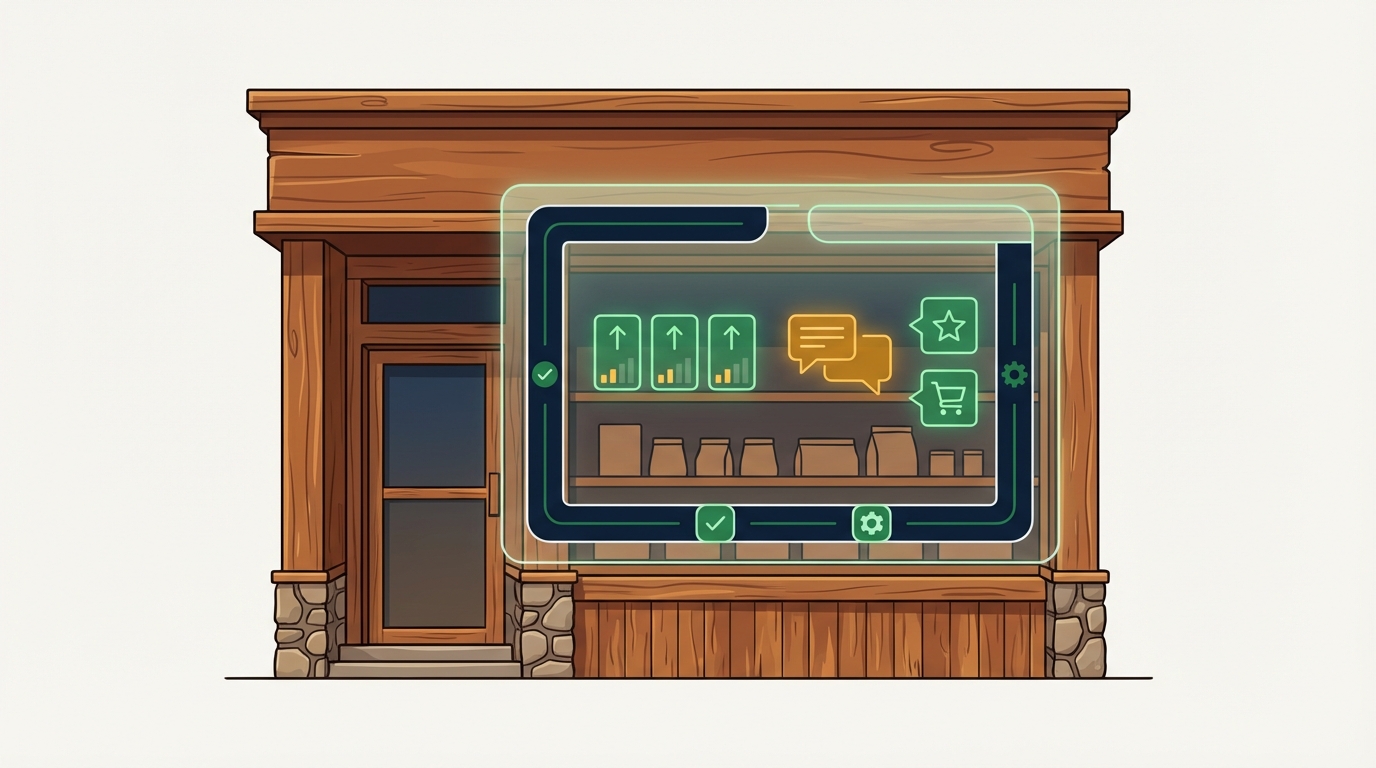
The stack above isn’t theoretical. These are tools available right now, most with free trials or free tiers. You don’t need to adopt everything at once. Start with the area that causes the most pain — usually inventory or customer communication — and expand from there.
For retailers who want a curated stack matched to their specific business, our small business solutions team can help you pick the right tools and get them connected.
What to expect in the next 12 months
Retail AI is accelerating. Based on what emerged at NRF 2026 and the pace of platform updates, here’s what small retailers should watch for:
Agentic commerce is coming. AI shopping assistants — from ChatGPT to Google’s shopping agent — will browse your store on behalf of customers. If your inventory is accurate and your product data is clean, these agents will send customers your way. If not, they’ll send them to your competitor. Shopify’s agentic storefronts are already live.
Voice commerce will grow. Customers will increasingly ask their smart speakers to reorder from local shops. Having your inventory connected and your business listed accurately online positions you to capture these sales.
AI costs will keep dropping. The massive AI infrastructure investments by companies like Google, Meta, and NVIDIA are expanding capacity. More capacity means lower prices for the AI tools built on top of it. Tools that cost $100/month today may cost $50 by year’s end.
Integration gets easier. The trend is toward unified platforms where inventory, customer service, marketing, and analytics all share data. Fewer manual connections, fewer data silos, better insights.
Start where it hurts
You don’t need to transform your entire operation overnight. Pick the problem that costs you the most — missed sales from stockouts, lost customers from slow responses, or wasted hours on manual tasks — and solve that first.
AI tools for retail are no longer luxury technology reserved for national chains. They’re practical, affordable, and designed for businesses your size. The retailers who adopt them now will have a meaningful advantage over those who wait — not because the technology is magic, but because it frees you to do what you do best: serve your community and grow your business.
If you’re ready to explore what AI can do for your retail operation, get in touch and we’ll help you find the right starting point.