
AI on a Small Business Budget: What to Buy, Build, or Skip
The small business AI spending reality
Two years ago, AI felt like something only big companies could afford. That is no longer true. A QuickBooks survey found that 68% of U.S. small businesses now use AI regularly, up from 48% in mid-2024. The small business AI budget conversation has shifted from “should we?” to “where should we spend?”
But spending is not the same as spending wisely. A Reimagine Main Street survey of 1,000 small businesses found that 74% of non-adopters would move forward if they had clearer ROI evidence. The hesitation is not about technology. It is about money.
Here is the honest breakdown. Some AI tools pay for themselves within weeks. Others are expensive experiments. And a few are pure hype that will drain your budget with nothing to show for it.
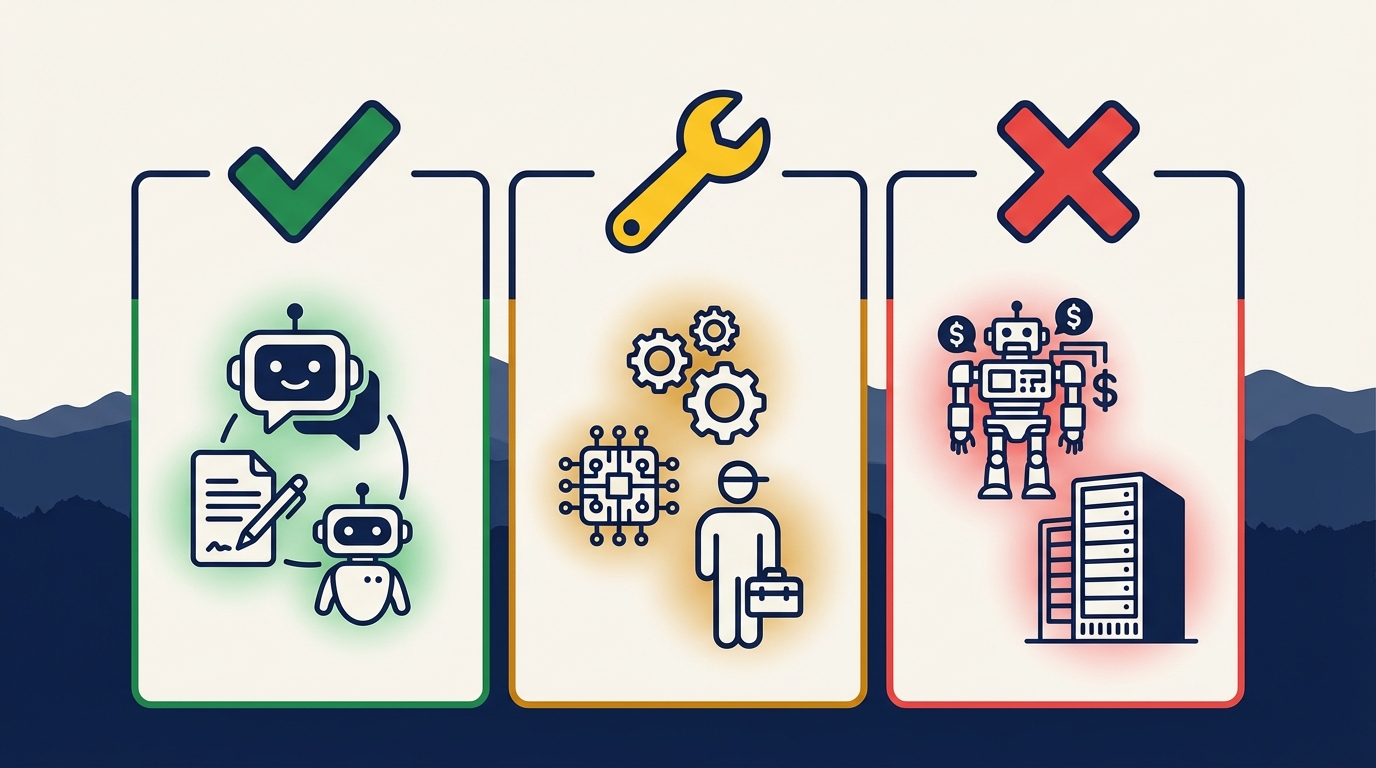
Buy: AI tools with proven small business ROI
These categories have strong track records for small businesses. The technology is mature, the pricing is accessible, and the ROI is measurable.
AI answering and intake
Missing calls costs real money. An AI answering service captures leads 24/7, qualifies inquiries, and books appointments while you sleep. Tools like Hollr start at a fraction of what a live answering service charges and handle unlimited conversations simultaneously.
Typical ROI: $500-$2,000/month in recovered revenue from calls you would have missed, according to Thryv research. If you run a service business — plumbing, HVAC, auto repair, legal — this is the single highest-impact AI investment you can make.
AI customer service and chat
The chatbot vs. live chat comparison is not even close for most small businesses. AI chat costs roughly 90% less than staffing live agents and handles routine questions instantly. Your customers get faster answers. You get back hours every week.
For service businesses, the sweet spot is an AI chatbot that handles common questions and escalates complex issues to a human. You do not need to choose one or the other.
AI content creation
Content marketing still has the best ROI of any digital marketing channel, but most small businesses cannot afford a content team. AI writing tools let you create blog posts, email campaigns, and social media content in a fraction of the time.
Content Forge turns voice recordings into polished blog posts. Record a five-minute voice memo about something you know well, and the AI handles transcription, structure, and drafting. It is not going to replace a professional copywriter for high-stakes brand work, but for consistent blog content and email newsletters, it gets the job done.
AI review management
Online reviews directly affect revenue. BrightLocal research shows that a one-star improvement on Google can increase revenue by 5-9%. AI review management tools monitor platforms, draft personalized responses, and flag negative reviews for immediate attention. At $30-$100/month, the math is straightforward.
AI scheduling and dispatch
For businesses that send teams into the field — contractors, cleaning services, property managers — AI scheduling tools reduce no-shows, optimize routes, and automate booking. The time savings alone justify the cost, and reduced drive time means lower fuel expenses.
Build: custom AI solutions worth the investment
Not everything you need comes off the shelf. Sometimes you need an AI tool built around your specific workflow. The build category is for businesses ready to invest more upfront for a bigger competitive advantage.
Industry-specific AI employees
Generic chatbots handle generic questions. An AI employee trained on your industry — your services, your pricing, your FAQs — handles the questions your customers actually ask. A restaurant AI that knows your menu and hours is more useful than a general-purpose chatbot that gives vague answers.
Building a custom AI agent costs more than subscribing to a generic tool, but the conversion rate difference is significant. An AI that speaks your business language earns trust faster.
AI workflow automation
Connect your existing tools with AI-powered automation. When a new lead comes in through your website, AI can qualify the inquiry, add it to your CRM, send a personalized follow-up email, and alert your team — all within seconds. The individual steps are simple. The combination is powerful.
The key: start with one workflow that costs you the most time or money. Automate that first. Then expand.
Custom analytics dashboards
Off-the-shelf analytics tools show you what happened. AI-powered dashboards predict what will happen next. Demand forecasting, inventory optimization, and staffing predictions all depend on your specific data patterns. A custom solution trained on your historical data outperforms generic tools by a wide margin.
This makes sense for businesses with enough transaction volume to train a model — typically 6+ months of data and hundreds of transactions per month.
Skip: AI hype that is not ready for small business
Not every AI tool deserves your budget. These categories either cost too much, deliver too little, or are not mature enough for small businesses in 2026.
Fully autonomous AI agents (for now)
The promise: AI that handles entire business processes end-to-end with zero human oversight. The reality: McKinsey’s 2025 State of AI survey found that only 7% of organizations have fully scaled AI across their operations. Even among large enterprises. For small businesses, the technology is not reliable enough to run unsupervised on high-stakes tasks like billing, payroll, or legal compliance.
Use AI to assist and accelerate these processes. Do not hand them over completely. Not yet.
AI-generated video and synthetic media
AI video tools have improved dramatically, but they still require significant editing time and the output quality varies wildly. For most small businesses, a smartphone video with good lighting outperforms a $200/month AI video subscription. Spend your video budget on content, not generation tools.
Enterprise AI platforms
Salesforce Einstein, Microsoft Copilot for Enterprise, IBM Watson — these platforms are built for companies with dedicated IT teams and six-figure software budgets. If you have fewer than 50 employees, you are paying for features you will never use. Look for tools built specifically for small businesses.
AI-powered CRMs (with AI pricing premiums)
Some CRM providers are slapping “AI-powered” labels on basic features and charging 2-3x more. Auto-tagging emails, suggesting next steps, and basic lead scoring are not worth a premium tier if the base CRM already handles your pipeline. Before paying extra for AI features, ask: does this actually save me time or money, or does it just sound impressive?
How to evaluate AI tools for your business
Before you spend a dollar on AI, run every tool through this checklist:
-
What specific problem does it solve? Vague promises like “boost efficiency” are red flags. Good tools solve measurable problems: reduce response time, cut no-shows, recover missed leads.
-
What does it cost per month, all in? Include setup fees, per-seat charges, API costs, and overage pricing. Some tools look cheap until you hit usage limits.
-
Can you measure the ROI within 30 days? If a tool needs six months to show results, it is either too complex for your current needs or not solving a real problem.
-
Does it integrate with your existing tools? An AI scheduling tool that does not sync with your calendar creates more work, not less. Check integrations before you commit.
-
What happens to your data? Know where your customer data goes and who can access it. This matters for trust and compliance.
The SBA’s Office of Advocacy research confirms that small businesses are closing the AI adoption gap with large firms. The key difference between businesses that succeed with AI and those that waste money on it: workflow redesign. Adding AI to a broken process gives you a faster broken process. Fix the workflow first, then automate it.
The $50/month AI starter stack
You do not need a massive budget to start. Here is a practical AI stack for under $50/month that covers the basics:
| Tool category | Monthly cost | What it does |
|---|---|---|
| AI chat/intake widget | $0-$29 | Captures leads and answers questions 24/7 |
| AI writing assistant | $0-$20 | Blog posts, emails, social media drafts |
| AI review monitoring | $0-$15 | Tracks reviews, drafts responses |
| AI scheduling | Free tier | Automates booking and reminders |
Start with the tool that solves your biggest pain point. If you lose leads after hours, start with AI intake. If your online reputation needs work, start with review management. If you are invisible online, start with content.
The businesses seeing the best results from AI are not the ones spending the most. They are the ones spending on the right things — tools that solve real problems, integrated into workflows they have already cleaned up.
Where to start
Pick one problem. One tool. Give it 30 days. Measure the results. Then decide whether to expand. That is how every successful small business AI adoption story begins — not with a massive technology overhaul, but with a single smart bet.
If you are not sure which AI tool fits your business, talk to our team. We help Appalachian businesses cut through the noise and invest in AI that actually pays off.