AI for Construction: Bids, Schedules, and Safety
Construction has an efficiency problem
The construction industry is one of the largest in the world at roughly $12 trillion in annual output. It is also one of the least digitized. Between 2000 and 2022, construction productivity grew at just 0.4% per year compared to 3.0% in manufacturing, according to McKinsey. That gap is not just an academic curiosity. It shows up in blown budgets, missed deadlines, and razor-thin margins.
If you run a construction company, you already know this. Bids take too long to prepare. Schedules fall apart when a supplier is late or weather shuts down a site. Safety incidents cost lives and money. And finding skilled workers has never been harder, with 82% of firms struggling to fill craft positions according to the Associated General Contractors of America.
AI is starting to change this. Not with robots replacing your crew, but with software that makes your existing team faster, more accurate, and safer. Sixty-one percent of construction firms now use AI or plan to increase their AI investment in 2026, up from 44% last year. Here is what that looks like in practice.
AI-powered bid estimation
Bid preparation is where construction companies win or lose work. Underbid and you eat the cost. Overbid and you lose the contract. Traditional estimation relies on manual takeoffs, historical gut feel, and spreadsheets that grow more complex with every project.
AI estimation tools change the math. They process plan sets 60% faster than manual takeoff methods while delivering 15-25% fewer change orders through more accurate initial pricing. Nearly half of construction firms now use AI-based cost estimation, and those firms report 19-24% lower budget variance compared to manual methods.
How AI estimation works
AI estimating software ingests your blueprints, specs, and historical project data. It identifies materials, quantities, and labor requirements by reading drawings the way an experienced estimator would, but faster and without fatigue. The system cross-references current material prices, local labor rates, and your company’s historical cost data to generate a bid that reflects real-world conditions.
The practical benefit is not just speed. AI catches inconsistencies between drawings and specifications that humans miss under deadline pressure. When a structural detail conflicts with a mechanical drawing, the system flags it before you submit a bid based on incomplete information.
What this means for small contractors
You do not need an enterprise budget to use AI estimation. Cloud-based tools like Autodesk Estimate, Procore’s AI features, and specialized platforms like STACK and Togal.AI offer subscription pricing that scales with your project volume. The construction estimating software market reached $2.73 billion in 2025 and is growing at nearly 13% annually, which means more competition and lower prices for buyers.
For a small contractor doing five to ten bids per month, cutting bid prep time by even 40% frees up your estimator to pursue more work or spend more time on accuracy. That is the difference between winning three jobs a month and winning four.
Project scheduling with AI
Construction schedules are living documents. They change when materials are delayed, when weather shuts down a site, when a subcontractor falls behind, or when an inspection gets pushed. Traditional scheduling tools show you what was supposed to happen. AI scheduling tools show you what is likely to happen next, and what to do about it.
Adaptive scheduling in real time
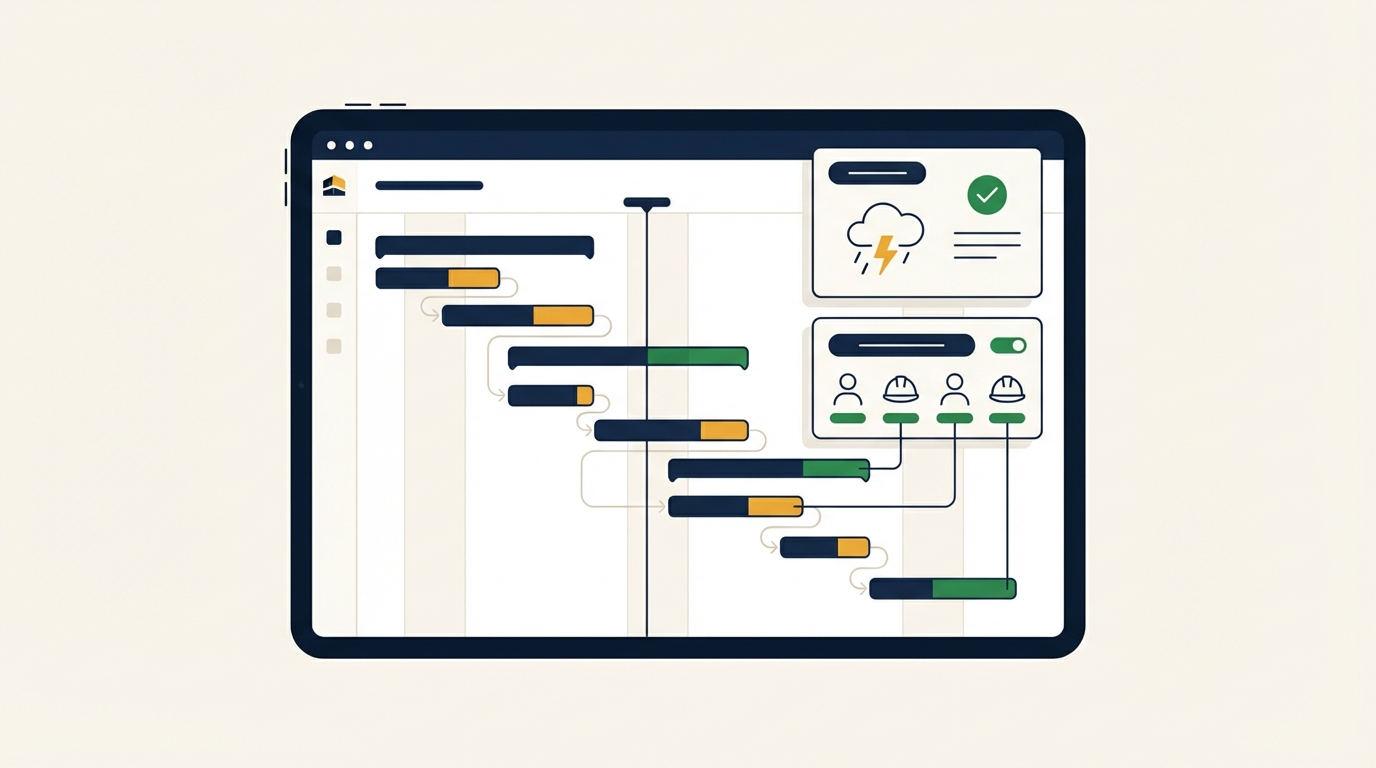
AI-powered scheduling absorbs data from multiple streams: delivery timelines, crew capacity, weather forecasts, and historical delay patterns. It dynamically updates your project timeline to reflect changing conditions instead of waiting for your project manager to manually adjust a Gantt chart.
When a concrete delivery slips by two days, the system does not just move that task. It recalculates the cascade effect on every downstream activity, identifies which crews will be idle, and suggests resequencing options to minimize total delay. This kind of analysis takes a human hours. AI does it in seconds.
Reducing the scheduling bottleneck
The AGC’s 2026 outlook found that 63% of firms plan to add headcount this year, but labor remains the industry’s biggest constraint. When you cannot hire enough people, you need the people you have working on the right tasks at the right time. AI scheduling optimizes crew deployment so you are not paying a framing crew to stand around while you wait on an inspection that should have been scheduled three days earlier.
If you have used AI scheduling in HVAC dispatch or appointment booking, the concept is similar. The difference is complexity. Construction projects involve dozens of interdependent tasks, multiple subcontractors, and longer timelines. The AI has more variables to work with, which is exactly where it outperforms manual methods.
Safety monitoring and compliance
Construction is dangerous work. OSHA reports 1,075 deaths in the construction industry in 2023, accounting for roughly 20% of all workplace fatalities in the United States. The “Fatal Four” causes — falls, struck-by-object, electrocution, and caught-in/between — account for about 60% of those deaths. Falls alone represent 39% of construction fatalities.
The financial cost is staggering. Construction-related injuries and fatalities cost the industry $11.5 billion annually. The average medically consulted injury costs $40,000, and OSHA penalties for willful violations can reach $165,514 per incident.
Small businesses are disproportionately affected. Firms with 1-10 workers account for 57% of fatal injuries, with over 70% of deadly falls occurring in small operations.
How AI improves jobsite safety
AI safety systems use computer vision — cameras and sensors on the jobsite — to monitor conditions in real time. They identify unsafe behaviors such as workers without hard hats, improper scaffolding, or unauthorized personnel in hazard zones. When the system detects a risk, it sends an immediate alert to the site supervisor.
This is not a replacement for a safety officer. It is an extra set of eyes that never blinks and never takes a break. A camera mounted at a site entrance can verify that every worker entering is wearing the required PPE. Drone-mounted AI can survey a roofing job and flag areas where fall protection is inadequate before anyone gets hurt.
Predictive safety analytics
Beyond real-time monitoring, AI analyzes historical incident data to predict where the next problem is likely to occur. If your company’s data shows that most incidents happen during the first two hours of a shift, or on Mondays after weekends off, the system can flag those patterns and recommend targeted safety briefings.
Some contractors are combining AI safety monitoring with their scheduling systems. If the weather forecast shows high winds on Thursday and you have a crane lift scheduled, the system can flag the conflict before your crew shows up and finds they cannot work.
Getting started with AI for your construction business
You do not need to overhaul your entire operation to start using AI. The most practical approach is to pick one pain point and solve it.
Start with estimation
If you spend more than a day preparing each bid, AI estimation tools will give you the fastest return. Start with a cloud-based platform that integrates with your existing drawing formats. Run a few parallel bids — one manual, one AI-assisted — to calibrate your confidence in the output.
Add scheduling next
Once your bids are more accurate, turn to scheduling. AI scheduling works best when it has data to learn from, so start feeding it your project timelines, actual completion dates, and delay causes. The more historical data it has, the better its predictions become.
Layer in safety monitoring
Safety AI requires hardware — cameras, sensors, or drones — so it has a higher upfront cost. Start with high-risk areas: rooftops, excavation zones, or crane operation areas. Even a single camera with AI monitoring at your most dangerous location can prevent a six-figure incident.
Evaluate your options
The AI in construction market is projected at over $4.86 billion in 2026 and growing rapidly. That means more tools, more competition, and better options for small contractors. If you are not sure where to start, an AI consulting engagement can help you identify which tools fit your workflow and budget.
For a broader look at which AI investments make sense and which are not worth the money yet, read our guide on AI on a small business budget.
The bottom line
Construction’s productivity gap is real, and it is getting harder to close with labor alone. AI does not replace your crew. It makes your estimators faster, your schedules more resilient, and your jobsites safer. The contractors adopting these tools now are not just saving money — they are winning more work because they can bid faster and deliver more reliably.
The AI in construction market is growing at over 24% annually, which means the tools available today will be significantly better and cheaper within a year. Waiting another year means competing against contractors who did not wait.
If you are a construction company in Appalachia looking to modernize your operations, Appalach.AI can help you evaluate and implement the right AI tools for your business. Start with one problem, prove the ROI, and scale from there.