
Why Appalachian Businesses Need AI Now, Not Later
71% of small businesses are already using AI. Where does yours stand?
That number comes from a February 2026 survey by the Small Business Expo — 693 small business owners polled, and nearly three out of four are actively using AI in some part of their operations. A year ago, that figure was closer to 50%. The adoption curve is not flattening. It is accelerating.
For Appalachian businesses, this creates an uncomfortable question. The region’s small businesses have always competed on grit, relationships, and deep local knowledge. Those advantages are real and they are not going away. But when a competitor down the road starts answering every call at midnight, responding to every Google review within minutes, and sending personalized follow-ups without lifting a finger — grit alone stops being enough.
This is not a pitch to chase the latest trend. It is a clear-eyed look at where the Appalachian business landscape is heading, what the numbers actually say, and why waiting another year could cost more than acting today.
The AI adoption curve — and where Appalachia falls on it
The national picture is clear. McKinsey’s 2025 State of AI report found that 78% of organizations now use AI in at least one business function. Generative AI use has doubled in under a year. Twenty-three percent of companies are already scaling AI agent systems across their operations.
But those numbers skew heavily toward larger companies and metro areas. Company size is one of the strongest predictors of AI adoption — firms with more than 500 employees adopt at roughly twice the rate of those with fewer than 50. Geography matters too. Regions with stronger digital infrastructure, larger concentrations of tech-savvy workers, and clearer regulatory guidance report faster adoption.
Appalachia sits at the intersection of both disadvantages. Smaller businesses. Weaker broadband infrastructure. Fewer technology professionals per capita. According to the Appalachian Regional Commission’s 2025 Chartbook, the region’s 107 rural counties lag behind on educational attainment and household income. Broadband access, while improving, still trails the national average by nearly four percentage points.
The gap is narrower than you think
Here is the good news. The SBA’s Office of Advocacy found that the AI adoption gap between small and large businesses is far smaller than it was with previous technology waves. When broadband was near-universal among large firms in 2004, only 48% of small businesses had high-speed access. With AI, the gap is narrower because the tools live in the cloud. You do not need a server room or an IT department. You need a browser and a reasonable internet connection.
The Census Bureau’s Business Trends and Outlook Survey shows small business AI adoption jumped from 3.7% to 18.2% since fall 2023. That is a five-fold increase in roughly two years. Among the small businesses that have adopted AI, 78.6% report that it has reduced costs or improved efficiency.
The window is open. The tools are affordable. But the window will not stay open forever — because the businesses that move first capture advantages that compound over time.
First-mover advantage in rural markets
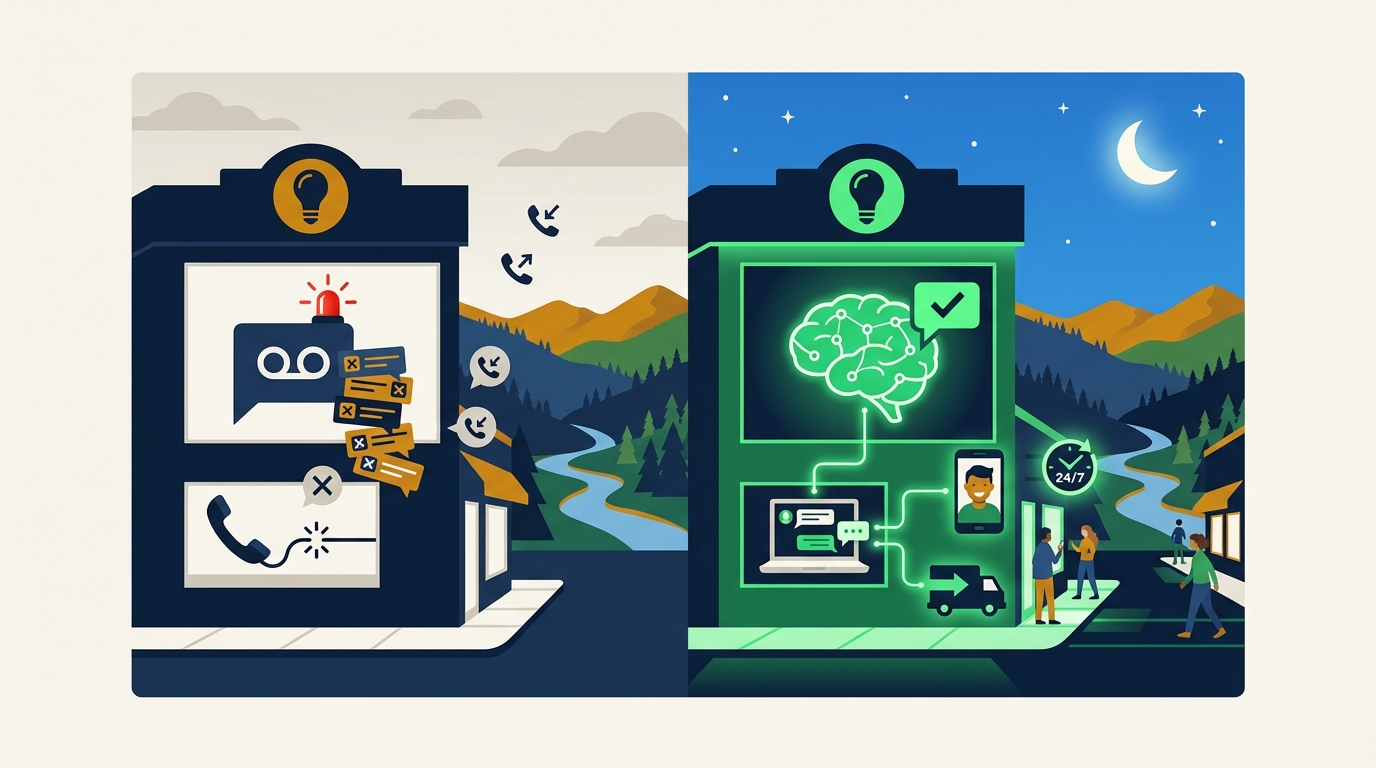
In a metro area, being an early AI adopter gives you a slight edge among hundreds of competitors. In a rural market, it can make you the only game in town.
Fewer competitors means bigger upside
Appalachian markets are smaller by definition. Many towns have one plumber, a few restaurants, two or three auto repair shops. When one of those businesses starts using AI to capture every after-hours lead, respond to every review, and maintain a consistent online presence, the competitive impact is outsized.
Consider a concrete example. Two HVAC contractors serve a county of 30,000 people. One implements AI-powered dispatch and scheduling — every call gets answered, every appointment gets confirmed with a reminder, and routing is optimized to minimize drive time. The other relies on a paper calendar and a part-time receptionist who works 9 to 5.
During a February cold snap, both phones ring off the hook. The first contractor captures every lead and books them efficiently. The second misses 40% of calls that come in after hours or during service runs. By the end of the month, the first contractor has handled 30% more jobs — not because they are better at HVAC, but because they never let a customer slip through the cracks.
Reputation compounds
Online reviews are the word-of-mouth of 2026. BrightLocal’s research shows that 87% of consumers read online reviews for local businesses. In a small market, a business with 150 thoughtful review responses looks dramatically more professional than one with 20 unanswered reviews — even if the underlying service quality is identical.
AI review management tools make this gap easy to create and hard to close. The business that starts managing reviews with AI today builds a reputation advantage that takes a competitor months or years to match.
Local SEO rewards consistency
Google’s local search algorithm favors businesses that maintain fresh content, active review profiles, and consistent business information. AI tools automate all three. A business that uses AI to publish regular blog content, respond to reviews, and keep its local SEO profile current will steadily climb local search rankings. A competitor who starts six months later has six months of ground to make up — and the algorithm rewards the one who has been consistent longer.
The real cost of waiting
The cost of adopting AI is easy to calculate — a monthly subscription, some setup time, a learning curve. The cost of waiting is harder to see because it shows up as opportunities you never knew you missed.
Lost leads add up fast
Research from Invoca estimates that 62% of calls to small businesses go unanswered. At an average lead value of $200-$500 for service businesses, missing even five calls a week translates to $4,000 to $10,000 per month in lost potential revenue. An AI answering service that costs $50-$150 per month can capture those leads around the clock.
The math is not subtle. And every month you wait is another month of leads walking to whoever picks up the phone.
Your competitors are not waiting
That 71% adoption figure is a national average. In some service industries — real estate, professional services, retail — adoption rates are even higher. If you are in the 29% that has not started, the question is not whether your competitors will adopt AI. It is whether they already have.
In January 2026, the U.S. House passed the AI for Main Street Act with a 395-14 vote, directing the SBA’s Small Business Development Centers to provide AI training and guidance to small businesses. When Congress passes a bill nearly unanimously, it is responding to a trend that has already become mainstream — not anticipating one.
The learning curve is steeper later
AI tools are getting easier to use, but they still require some time to configure, train on your business data, and integrate into your workflow. Businesses that start now have the luxury of learning at their own pace. Businesses that start in a panic — because a competitor just ate their lunch — do not.
Every AI system also improves with data. A chatbot that has handled six months of customer inquiries is meaningfully better than one that launched yesterday. The AI learns your customers’ common questions, your scheduling patterns, and your service areas. That institutional knowledge cannot be shortcut.
Low-cost AI tools you can start with today
You do not need a big budget to start. You do not need technical expertise. Here are the highest-impact, lowest-barrier AI tools for Appalachian businesses.
AI answering and intake ($50-$150/month)
An AI answering service handles calls and website inquiries when you cannot — nights, weekends, during service calls. It captures caller information, answers common questions, and books appointments directly into your calendar.
For service businesses — plumbers, electricians, HVAC contractors, property managers — this is the single highest-ROI AI investment. See how Hollr works for an example of what this looks like in practice.
AI review management ($30-$100/month)
These tools monitor your reviews across Google, Facebook, Yelp, and industry-specific platforms. They draft personalized responses you can approve with one tap and flag negative reviews for immediate attention. Five Star AI handles this for businesses across several industries.
AI scheduling and dispatch ($50-$200/month)
If you send people into the field, AI scheduling reduces no-shows, optimizes routes, and automates confirmations. Dispatch AI is built specifically for contractors and service businesses in the Appalachian region.
AI content creation ($0-$50/month)
Consistent content drives local SEO, and AI makes it realistic for a one-person operation. Record a five-minute voice memo about something you know, and Content Forge turns it into a polished blog post. Free-tier options like ChatGPT can handle social media captions and email drafts.
Total starter cost: under $200/month
A realistic AI stack for a small Appalachian business — answering, reviews, and content — runs $80-$300 per month. Compare that to hiring a part-time receptionist ($1,500+/month), a marketing consultant ($2,000+/month), or a reputation management agency ($500+/month). The budget breakdown is not even close.
The 30-day AI quickstart for Appalachian businesses
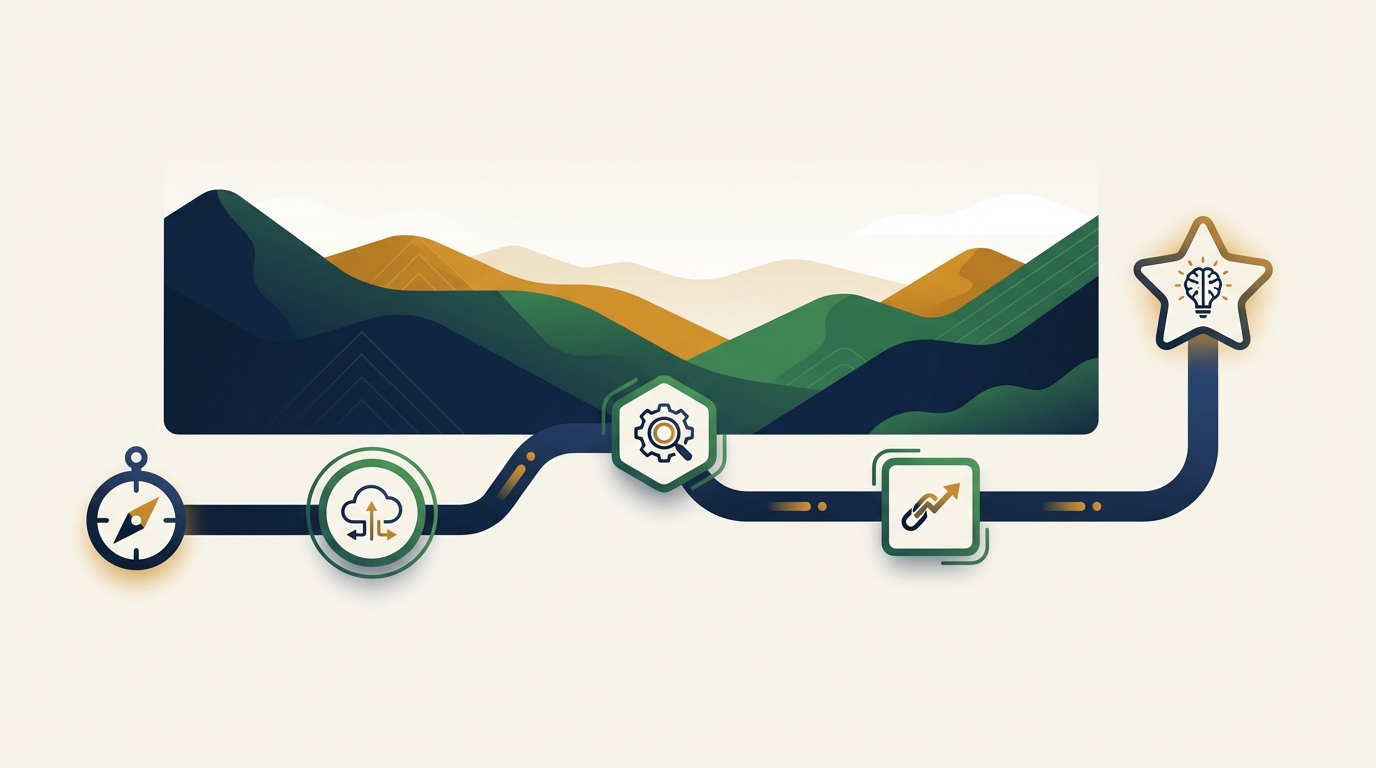
You do not need to overhaul your business. You need to start with one tool that solves one real problem, prove the value, and expand from there.
Week 1: identify your biggest leak
Every business has a point where leads, time, or money seep out. For most service businesses, it is missed calls. For retailers, it might be unanswered reviews. For hospitality operators, it could be slow response times on booking inquiries.
Pick the one problem that costs you the most. Do not try to fix everything at once.
Week 2: set up one AI tool
Choose the tool that addresses your biggest leak. Set it up. Most AI tools designed for small businesses can be configured in under an hour. If you get stuck, the SBA’s Small Business Development Centers now offer AI guidance — and it is free.
Week 3: let it run and measure
Resist the urge to tinker constantly. Let the tool handle real customer interactions for a full week. Track the numbers: How many calls did it answer? How many appointments did it book? How many reviews did it respond to?
Week 4: evaluate and decide
Compare your numbers to the month before. If the tool captured even a handful of leads you would have otherwise missed, it has likely already paid for itself. If it did not, you have lost $50-$150 and gained clarity on what you actually need. Either way, you are further ahead than you were.
Washington is betting on AI for small business
This is not just a market trend. Federal policy is actively pushing AI into the hands of small businesses.
The AI for Main Street Act directs the SBA to provide AI training through its nationwide network of Small Business Development Centers. The companion AI-WISE Act creates educational resources and best-practice guides. Senators Cantwell and Moran introduced the Small Business Artificial Intelligence Training Act, authorizing the Department of Commerce to develop and distribute AI training specifically for small businesses.
Meanwhile, NIST allocated $3.19 million to eight small businesses for AI research and development under the SBIR program. The Appalachian Regional Commission’s 2026 conference specifically highlights AI in economic development as a key topic.
The infrastructure is being built — policy, funding, and training programs — for small businesses to adopt AI. The question is whether you take advantage of it now or wait until the next wave of competitors already has.
The Appalachian advantage
There is a narrative about Appalachia that focuses on what the region lacks — broadband, capital, technical talent. That narrative misses what the region has in abundance.
Deep customer relationships. In communities where the plumber knows the homeowner by name and the restaurant owner coaches Little League, AI does not replace the personal touch. It frees up time to deliver more of it. When a tool handles your midnight calls and review responses, you get to spend your energy on the relationships that built your business.
Resourcefulness. Appalachian business owners have always done more with less. AI is the ultimate force multiplier for that mindset. A $100/month tool stack gives a one-person operation capabilities that used to require a team of five.
Less competition for attention. In a market of three HVAC companies, being the one with a polished online presence and 24/7 availability is transformative. In a market of three hundred, it is incremental. Rural markets reward early movers disproportionately.
The businesses that thrive in Appalachia over the next five years will not be the ones that resisted change. They will be the ones that married the region’s traditional strengths — community, hard work, personal service — with tools that amplify what they are already good at.
If you are ready to start, explore our AI solutions or get in touch for a conversation about what makes sense for your business. The best time to start was six months ago. The second-best time is today.