Digital Transformation in Appalachia: AI Closes the Gap
Seventy-five counties. That is the number classified as “economically distressed” across Appalachia’s 423-county region in 2026.
Behind that number is a harder truth: the businesses in those counties are competing in an economy that increasingly rewards digital fluency. While metropolitan areas race ahead with AI-powered operations and cloud-based everything, many Appalachian business owners still struggle with the basics — reliable internet, modern websites, online booking systems.
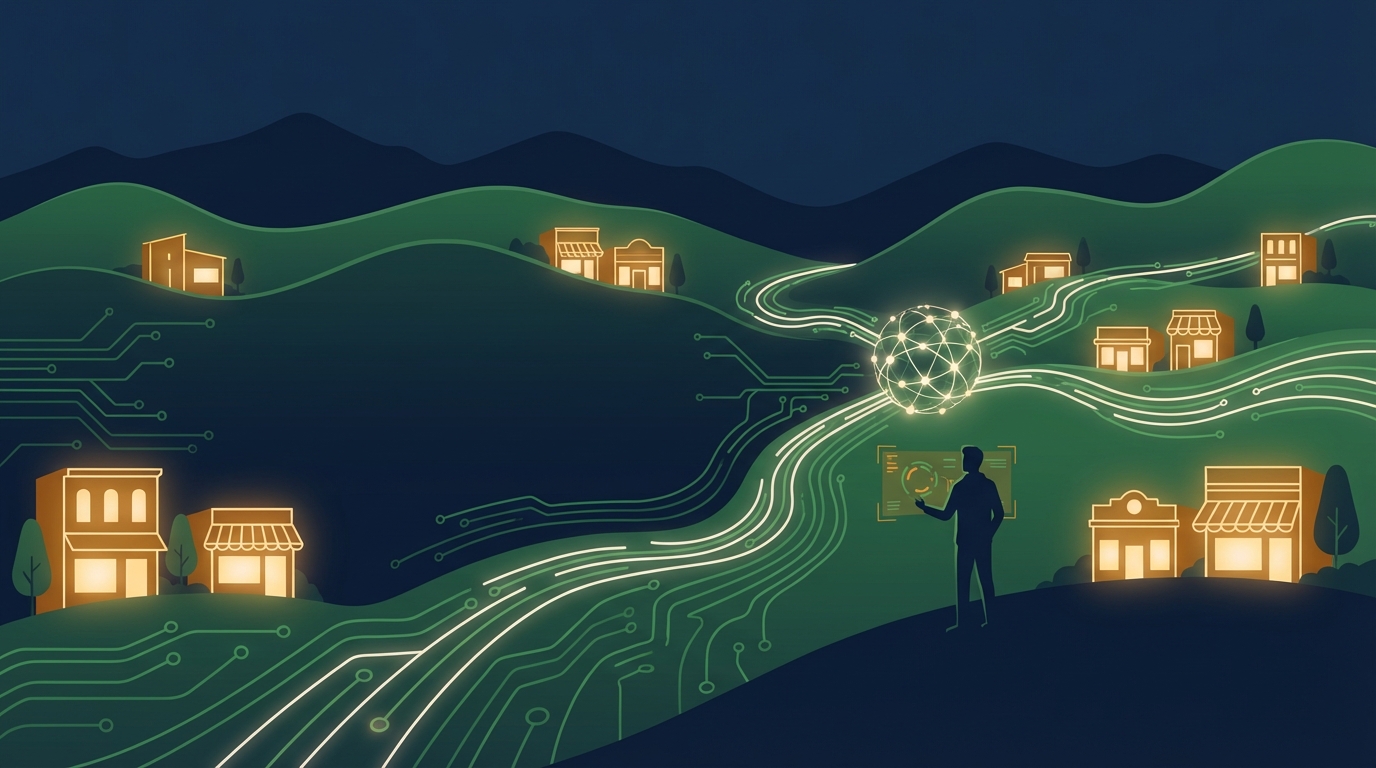
But something is shifting. Appalachian digital transformation is no longer a future aspiration. Billions of dollars in broadband infrastructure, a new generation of affordable AI tools, and hard-won resourcefulness are converging to close a gap that has defined the region for decades. This is how it is happening — and what it means for your business.
The digital divide in Appalachian business
The numbers paint a clear picture. According to the Appalachian Regional Commission’s 2025 Chartbook, 84.5% of Appalachian households have broadband internet — nearly four percentage points below the national average. In 116 Appalachian counties, fewer than 80% of households have a broadband subscription. Over two-fifths of those counties are rural.
West Virginia ranks last in the nation for fixed broadband connectivity according to FCC data.
The consequences for business are direct. A contractor who cannot load scheduling software reliably loses jobs. A bed-and-breakfast owner who cannot respond to booking inquiries within minutes loses guests to competitors. A restaurant that cannot process online orders during peak hours leaves money on the table.
The gap is economic, not just technological
Median family income in Appalachia sits at 85% of the national median. The poverty rate hovers around 14.3%. When every dollar matters, investing in technology feels like a luxury — even when the math says otherwise.
Research from the Center on Rural Innovation found that rural counties with broadband adoption rates above 80% see 213% higher business growth, 10% higher self-employment growth, and 44% higher GDP growth compared to counties with lower connectivity. The U.S. Chamber of Commerce estimates that closing the rural broadband gap could create 360,000 new full-time jobs and add $47 billion to the economy annually.
The divide is not just about wires in the ground. It is about the cascade of opportunities that open up — or stay closed — based on whether a business can participate in the digital economy.
Broadband and infrastructure: where we stand in 2026
The good news: infrastructure investment is arriving at a scale the region has never seen.
Federal funding is unprecedented
West Virginia alone received $1.2 billion through the BEAD Program for broadband infrastructure expansion. Kentucky secured $1.1 billion. Across the nation, the Infrastructure Investment and Jobs Act allocated $42.5 billion for broadband deployment.
The USDA’s ReConnect Program has invested $5.54 billion across five rounds, with specific Appalachian awards including $12.4 million for Nicholas County, West Virginia — serving 6,000 people and over 100 businesses.
West Virginia’s BEAD plan was approved in November 2025, with eight subgrantees now serving over 73,000 locations. The state also received over $9 million in Digital Equity Capacity Grants from NTIA, funding digital skills training, affordable device programs, and local digital equity planning.
Progress is real but uneven
Between the 2014-2018 and 2019-2023 periods, Appalachian broadband access increased by 11.1 percentage points. The rural-urban broadband gap within Appalachia narrowed from 13.7 to 9.6 percentage points.
That progress matters. But the FCC raised its broadband standard from 25/3 Mbps to 100/20 Mbps in 2024, which means many areas previously counted as “served” are now classified as underserved. By the new standard, 98% of urban Americans have adequate access compared to only 72% of rural Americans.
The infrastructure is coming. For businesses that can access it today, the question is no longer “when will we get connected?” but “what do we do with the connection we have?”
AI tools that work with limited resources
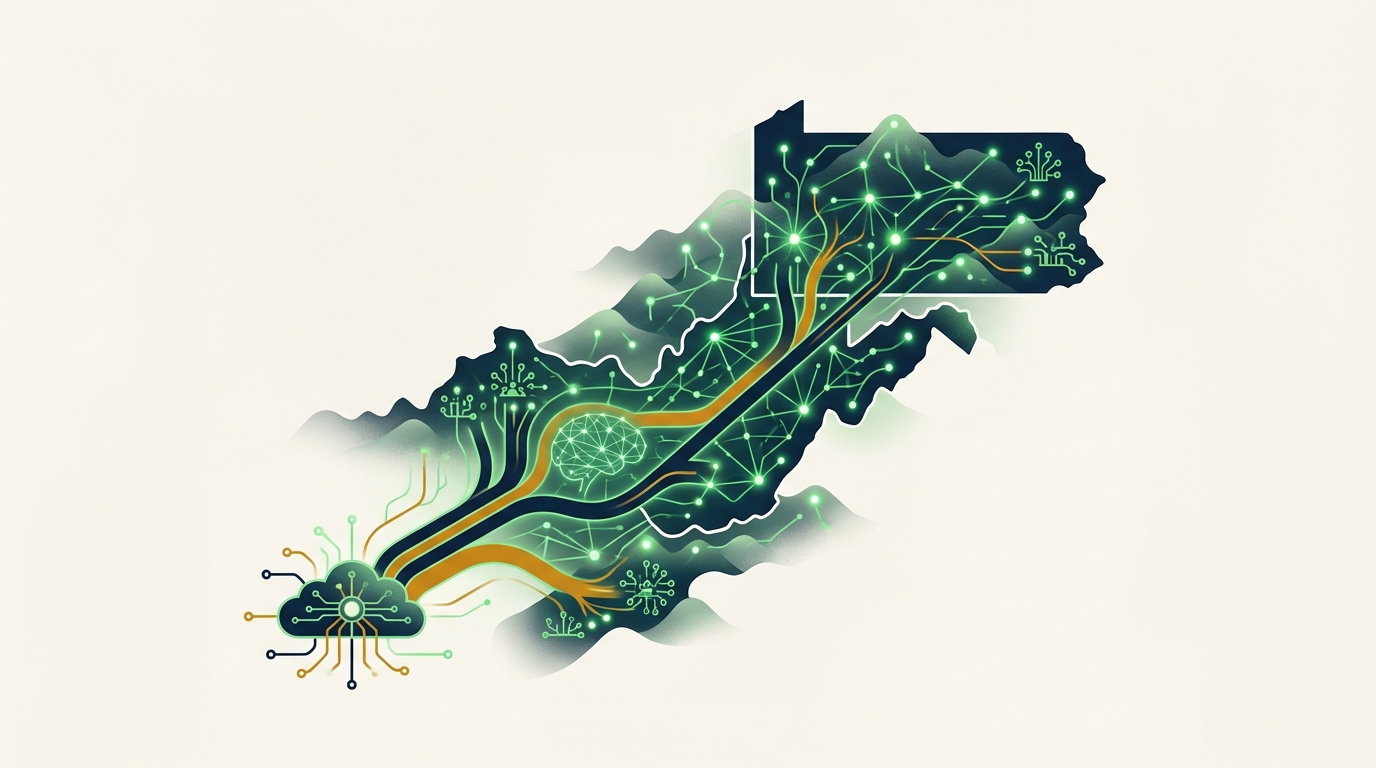
Here is where the story gets interesting. Unlike previous technology waves — which required expensive hardware, dedicated IT staff, and enterprise-level budgets — AI tools in 2026 are cloud-based, subscription-priced, and designed for small teams.
Why AI is different from past technology waves
The SBA notes that the AI adoption gap between small and large businesses is “far less than it was with broadband internet.” When broadband was near-universal among large firms in 2004, only 48% of small businesses had high-speed access. With AI, the gap is narrower because the tools live in the cloud. You do not need a server room. You need a browser and a reasonable internet connection.
The Census Bureau’s Business Trends and Outlook Survey shows small business AI adoption jumped from 3.7% to 18.2% since fall 2023. McKinsey’s 2025 State of AI report found 78% of organizations now use AI in at least one business function, with 65% regularly using generative AI — nearly double from ten months prior.
Practical AI for Appalachian businesses
The AI tools most relevant to small businesses in the region fall into a few categories:
Customer communication. AI answering services and intake widgets handle calls and website inquiries around the clock. For a plumbing company in Huntington or a property management firm in Lewisburg, this means never missing an emergency call or booking request — even at 2 AM, even during a busy Saturday.
Scheduling and dispatch. AI-powered scheduling tools automate appointment booking, send reminders, and reduce no-shows. For HVAC contractors dealing with seasonal surges, these tools turn scheduling chaos into a managed process.
Review and reputation management. Online reviews drive local business. AI tools monitor, respond to, and analyze reviews across platforms — turning a time-consuming task into a five-minute daily check.
Content and marketing. Small businesses that cannot afford a marketing team can use AI to generate blog posts, social media content, and local SEO-optimized pages. Tools like Content Forge turn a voice recording into a polished article in minutes.
The common thread: these tools do not require technical expertise. They require a willingness to try something new — a quality Appalachian business owners have never lacked.
Success stories from the region
The transformation is not theoretical. It is happening now, at scales both massive and modest.
From coal plant to AI campus
The most dramatic example is the Homer City Generating Station in Indiana County, Pennsylvania. Once the state’s largest coal plant, it was decommissioned in July 2023 after 55 years of operation. Now, a $10 billion project is converting the site into a gas-powered AI and data center campus capable of generating up to 4.5 gigawatts of power.
The project is expected to create over 10,000 construction jobs and roughly 1,000 permanent positions, while reducing CO2 emissions by 60-65% per megawatt-hour compared to the former coal plant. Appalachia has over 80 decommissioned coal plant sites with existing transmission infrastructure, road networks, and water access — each a potential hub for the AI economy.
AI in Appalachian education and entrepreneurship
Appalachian State University launched AI-focused master’s degree concentrations through its Walker College of Business, becoming one of the first institutions in the Carolinas to offer graduate-level AI business programs. This is not abstract academic work — it is training the next generation of business leaders who will bring AI fluency back to their communities.
The Accelerate Appalachia program selected five businesses for its 2025 entrepreneurial accelerator, including AI-in-healthcare startups operating within the Appalachian Highlands.
What small businesses are doing today
Research from East Tennessee State University found that AI can “significantly improve efficiency, streamline workflows, and enhance visibility for Appalachian entrepreneurs,” while acknowledging real barriers: trust concerns, limited resources, and resistance to change.
Those barriers are worth naming because they are worth addressing. A vacation rental operator in the New River Gorge who automates guest communication is not replacing the personal touch — they are freeing up time to deliver more of it. A restaurant owner in Charleston who uses AI to manage reviews is not being impersonal — they are making sure every customer feels heard.
The businesses adopting AI in Appalachia are not technology companies. They are plumbers, innkeepers, mechanics, and restaurant owners who decided the cost of standing still was higher than the cost of trying something new.

Government programs and resources for digital adoption
Federal and state programs are specifically targeting the digital divide in Appalachia. If you are a business owner in the region, these are the programs worth knowing about.
ARC POWER Initiative
The Appalachian Regional Commission’s POWER program has invested $485 million in 564 projects across 365 Appalachian counties since 2015. These investments have created or retained an estimated 54,000 jobs and prepared over 170,000 workers and students for the modern economy. In FY 2024 alone, $68.2 million went to 65 projects.
POWER grants have leveraged over $1.85 billion in additional private investment — a nearly four-to-one return.
ARC ARISE Initiative
Funded by the Bipartisan Infrastructure Law’s $1 billion allocation for ARC ($200 million per year through FY 2026), the ARISE initiative awarded $33.5 million to 12 multi-state projects across all 13 Appalachian states. Planning grants reach $500,000; implementation grants go up to $10 million.
West Virginia digital equity programs
West Virginia’s Digital Equity Capacity Grants fund three subgrant programs: digital skills training and digital navigators, an affordable device program, and digital equity planning for local governments. Two additional rounds are planned in 2025 and 2026, each estimated at over $3 million.
Generation West Virginia published digital equity plans for 18 counties to guide digital inclusion efforts and funding applications.
How to access funding
Most of these programs do not fund individual businesses directly. Instead, they fund regional organizations, local governments, and development districts that then provide services to businesses. The practical steps:
- Contact your local ARC development district to learn about current programs in your county
- Check the SBA’s local resource directory at SBA.gov for small business technology assistance programs
- Connect with your state’s broadband office — in West Virginia, that is broadband.wv.gov — to learn about digital equity subgrants
- Ask about SCORE mentoring at SCORE.org for free business technology guidance from experienced mentors
The opportunity in front of Appalachian businesses
The math is compelling. AI tools that cost $50-200 per month can replace tasks that previously required hiring additional staff or outsourcing to expensive agencies. For a region where the median family income is 85% of the national average, that affordability changes the equation entirely.
Appalachian businesses have an advantage that gets overlooked: tight-knit communities and deep customer relationships. AI does not replace that. It amplifies it. When you automate the administrative overhead — answering phones at midnight, responding to every Google review, keeping your website content fresh — you get to spend more time doing what built your business in the first place: showing up for your customers.
If you are in the 29% of small businesses that have not started using AI, the window to act is now. Not because AI is a fad you will miss, but because your competitors — in your town and in the next county over — are figuring it out. The tools are affordable, the learning curve is shorter than you think, and the results show up fast.
Appalach.AI exists because we believe Appalachian businesses deserve the same AI advantages as companies in Silicon Valley — without the Silicon Valley price tag. Whether you need an AI employee to handle customer calls, a better local SEO strategy, or help figuring out where to start, we are here to help.
The digital divide is closing. Make sure your business is on the right side of it.